
Page 5 / 5
Prev

@davidd I thought Dr Don W King was presenting a theory that the ‘seven deadly sins’ are integral to understanding the construction of the Narnian chronicles, as set out in his essay in Narnia: Seven Deadly Sins.
Thank you for the link to Dr King's essay on the Inside the Wardrobe site. 
 Whilst showing how your pattern might fit the other Narnia books besides The Last Battle, I didn't manage to include HHB, when I hadn't thought it through. I am reminded in his article, that Dr King had pointed out that the theme of the Seven Deadly Sins often occurs in other works, such as Geoffrey Chaucer's The Parson's Tale, or Piers Plowman, and that C.S. Lewis, as a Christian apologist, not only as a Professor of English, at firstly Oxford then Cambridge, would most certainly be familiar with that particular concept, all the more so as he was great friends with J.R.R. Tolkien, who famously saw Christianity through his Catholic upbringing. Dr King even mentions Pope Gregory 1st (540-605), who, like his predecessor the Pope Leo 1st, the only one left standing to lead Rome against Attila the Hun in 452 AD, was called Gregory the Great.
Luxuria, . . . is, in fact, something very like "luxury" in the modern meaning of the word-the sin of the profiteer" (70). That Lewis would choose to use luxuria in this sense is not surprising, considering that the bulk of his audience, young children, would be more likely to understand it as opposed to sexual immorality.
In the tale Prince Caspian's uncle, King Miraz, is clearly guilty of profiteering in his desire to gain power, wealth, and position
I was particularly encouraged by what Dr King said about King Miraz above, being such a profiteer, when I thought that Lord Berne's settling down with a family on the Lone Island, and the mere birth of his healthy son, were rather weak examples of what is meant by Lust.
I came to this position in a rather roundabout way. In 2005, as a Harry Potter fan, I was drawn into writing Scribbulus Essays for the Leaky Cauldron, and as the publication of this series progressed, I began to notice that despite the literary criticism levelled at C. S. Lewis at the time, JK Rowling seemed inspired & influenced by Lewis' writings. In particular, at a Book Week event in UK, JK Rowling started her address by comparing libraries with Lewis' The Wood between the Worlds" in MN. For Issue 6 of Scribbulus in August 2006, I wrote "Seven DADA teachers = Seven Missing Lords, & in March 2008, in issue 22, I wrote "The Peasant, the Tramp, and Hepzibah Smith: a horcrux case study" using again this theme of the Seven Deadly Sins. But this was from a Harry Potter point of view, rather than from the point of view of the Chronicles of Narnia, in particular, the Seven Missing Lords of The Voyage of the Dawn Treader. Therefore, on the 19th April of 2008, I wrote another essay for myself, this time, called Harry Potter sails the Dawn Treader . Using my amended HP table from this later essay, which I have shown below, I was able to work out the rest. I could probably do the same thing now for the Chronicles of Narnia.
| Book | Theme | DADA teacher | Sin | Heavenly virtue | Opposing virtue |
| PS/SS | Discovery | Quirrell | Greed | Temperance | Liberality |
| COS | Friendship | Lockhart | Lust (Exploitation) |
Prudence | Chastity (Fidelity) |
| POA | Discipline | Lupin | Gluttony | Justice | Abstinence |
| GOF | Competition | ’Moody’ | Envy | Courage | Kindness |
| OOtP | Authority | Umbridge | Anger | Faith | Patience |
| HBP | Service | Snape | Sloth or Laziness | Hope | Diligence (Perserverance) |
| DH | Fulfilment | Amycus Carrow | Pride | Charity | Humility |
By the way, I'm not the only one who criticised Seven DADA teachers = Seven Missing Lords, when in Issue 8 of Scribbulus, I found Hogwarts, School of the Virtues. 
And I'd agree with you when I left out HHB in my last post on this thread, in discussing how your pattern from LB fits other Narnia books.
But what are the main themes, anyway, in each of the Chronicles of Narnia?
And by the way, what other works have we seen around, have C.S. Lewis' writings influenced this way?
This post was modified 2 months ago 3 times by waggawerewolf27
Posted : March 24, 2026 6:38 pm
DavidD liked

But what are the main themes, anyway, in each of the Chronicles of Narnia?
Sorry, it is taking me way too long to follow up your post and reply properly - I will eventually 🙂 . This is an EXTREMELY partial reply only to the question of what I see as the main theme in The Magician's Nephew. Sorry, I haven't commented on the rest of your post.
When it comes to the themes of Narnia, I am fond of quoting C. S. Lewis’s letter to Anne Jenkins from the 5th March 1961:

Dear Anne– What Aslan meant when he said he had died is, in one sense, plain enough. Read the earlier book in the series called The Lion the Witch and the Wardrobe, and you will find the full story of how he was killed by the White Witch and came to life again. When you have read that, I think you will probably see that there is deeper meaning behind it. The whole Narnian story is about Christ. That is to say, I asked myself ‘Supposing there really were a world like Narnia, and supposing it had (like our world) gone wrong, and supposing Christ wanted to go into that world and save it (as He did ours) what might have happened?’ The stories are my answer. Since Narnia is a world of Talking Beasts, I thought He would become a Talking Beast there, as he became a Man here. I pictured Him becoming a lion there because (a) The lion is supposed to be the King of beasts: (b) Christ is called ‘The Lion of Judah’ in the Bible: (c) I’d been having strange dreams about lions when I began writing the books. The whole series works out like this:
The Magician's Nephew tells the Creation and how evil entered Narnia.
The Lion, the ……………………..the Crucifixion and Resurrection.
Prince Caspian……………………restoration of the true religion after corruption.
The Horse and His Boy………..the calling and conversion of a heathen.
The Voyage of the "Dawn Treader"…the spiritual life (specially in Reepicheep).
The Silver Chair …………………the continuing war with the powers of darkness.
The Last Battle…………………….the coming of the Antichrist (the Ape), the end of the world and the Last Judgement.
All clear!
Yours
C. S. Lewis
To my knowledge, this is the only time Lewis talked himself about the themes of each book. It seems like a good starting point.
The Magician’s Nephew may tell of “the creation and of how evil entered Narnia”, but I would not consider either ‘creation of Narnia’ or ‘how evil entered Narnia’ as themes as such. One blog by Kennedy Unthank suggests that the Fall of humanity is depicted in this book as it’s main theme (with the striking of the bell being the equivalent of eating the apple – this might be getting a little to close to allegorizing for me). Michael Ward saw this as the Venus book in the series. I do not agree wholeheartedly with either of these assessments, however both are at least a little bit helpful.
In my post on the Magician’s nephew thread , I commented that the two chiastic structures making up the two halves of the book each had a temptation scene at their climax. In the latter of those two scenes, Digory is tempted to eat an apple in a Garden and is also tempted to steal an apple to cure his mother. I think this is clear ‘Garden of Eden’ and Genesis 3 imagery. The earlier temptation scene (which does indeed result in evil entering Narnia in the person of Jadis) seems to me to be parallel to the later scene. Because Digory gives into his desire to strike the bell, evil enters Narnia, just as Adam and Eve’s disobedience leads to evil entering the world. So Kennedy Unthank’s thesis has some merit.
Likewise, in C. S. Lewis’s Science Fiction “Ransom trilogy”, the second book, “Perelandra”, takes place on the planet Venus and has traditional Venereal imagery (as imagery associated with Venus, Aphrodite or Frigg / Freyja). Lewis employs this imagery in this book to write a supposal of what would happen if a temptation occurred on the Planet of Venus like the Garden of Eden. He talked about this in a letter to a “Mrs Hook” on the 29th December 1958:
In reality however he is an invention giving an imaginary answer to the question, ‘What might Christ become like if there really were a world like Narnia and He chose to be incarnate and die and rise again in that world as He actually has done in ours?’ This is not an allegory at all. So in ‘Perelandra’. This also works out a supposition. (‘Suppose, even now, in some other planet there were a first couple undergoing the same temptation that Adam and Eve underwent here, but successfully.’)
Allegory and such supposals differ because they mix the real and the unreal in different ways. Bunyan’s picture of Giant Despair does not start from supposal at all. It is not a supposition but a fact that despair can capture and imprison a human soul. What is unreal (fictional) is the giant, the castle, and the dungeon. The Incarnation of Christ in another world is mere supposal: but granted the supposition, He would really have been a physical object in that world as He was in Palestine and His death on the Stone Table would have been a physical event no less than his death on Calvary.
Similarly, if the angels (who I believe to be real beings in the actual universe) have that relation to the Pagan gods which they are assumed to have in Perelandra, they might really manifest themselves in real form as they did to Ransom.
Again, Ransom (to some extent) plays the role of Christ not because he allegorically represents him (as Cupid represents falling in love) but because in reality every real Christian is really called upon in some measure to enact Christ. Of course Ransom does this rather more spectacularly than most. But that does not mean that he does it allegorically. It only means that fiction (at any rate my kind of fiction) chooses extreme cases….
Perelandra uses much fertility imagery for a ‘young world’ and tells the story of temptation from the feminine perspective of an “Eve” like character being tempted by the a serpent-like Dr Western. There are striking resemblances between Perelandra and the ‘temptation’ scenes in the Magician’s Nephew. (I consider the temptation scenes to include:
- Uncle Andrew’s Forbidden Study, where Polly is deceived by Uncle Andrew to take a ring from the table in the centre of the room,
- The Hall of Images, where Digory is tempted to strike the bell with the hammer in the centre of the room by the writing that Jadis must have left on the pillar beneath the hammer and
- The Garden scene, where Digory is tempted to take or eat an apple from the tree in the centre of the Garden by Jadis).
So, given that Lewis employs Venus-related imagery in telling a ‘new Eden’ story in Perelandra, which has remarkable similarity to several scenes in The Magician’s Nephew and given there is not merely the fertility imagery of creation, but Jadis is imagined as a corrupt, beautiful goddess and is somewhat contrasted to the good feminine traits in Digory’s own mother who is dying, I find Michael Ward’s theory at least somewhat helpful in understanding the book.
Where I think I would differ from both is that the theme seems to play out to me in the contrast between Digory giving into the temptation in the first instance (where he strikes the bell) and where he resists the temptation in the second instance in the garden (at great cost to himself and to his’ mother).
I pointed out in my other post, that in the first scene, Digory is behaving similar to Jadis and Uncle Andrew who both had behaved selfishly. In the second instance, Digory had met Aslan. Having met Aslan, Digory does the selfless thing.
Lewis says:
Digory never spoke on the way back, and the others were shy of speaking to him. He was very sad and he wasn’t even sure all the time that he had done the right thing; but whenever he remembered the shining tears in Aslan’s eyes he became sure.
Digory is sure when he remembers Aslan's character - that Aslan loves his mother and is more sorry for her sickness than Digory is himself. Digory can obey Aslan because he knows Aslan is trustworthy.
I think it is as if Lewis is saying “If Adam and Eve had remembered the good character of the one who had shown himself to be trustworthy in the things that they did understand, then they should have trusted him regarding this command that they did not understand.” Thus, I think this book is about Digory learning obedience; to do the right thing because he trusts in Aslan’s character.
This post was modified 2 months ago by DavidD
The term is over: the holidays have begun.
The dream is ended: this is the morning
Topic starter
Posted : March 26, 2026 10:18 am
waggawerewolf27 and coracle liked
@davidd To my knowledge, this is the only time Lewis talked himself about the themes of each book. It seems like a good starting point.
Yes, it is a definite starting point. And it seems that the same spirituality also infuses C.S Lewis' Space Trilogy, which consists of 1stly "Out of the Silent Planet", which deals with Mars, the seemingly desolate companion to our own Earth. You talk about "Perelandra" which seems far and away the most delightful of his trilogy, in contrast to the horror of Venus' Space Age reality. But it is more of an adult book like "Till we have faces", & more directed at a senior high school/tertiary level, and the nearest I have read in more junior adult literature is New Zealander Ken Catran's Doomfire on Venus, my favourite of his otherwise bleak "Solar Colonies" science fiction trilogy, not fantasy fiction at all, unlike Chronicles of Narnia, definitely directed at Primary and Secondary school aged children.
The only one of Lewis' Space trilogy that I own, myself, is That Hideous Strength. Unlike the first two books which I have read, I have never actually read it, would you believe? Being put off by its actual title, in a way. But I can't dispose of this book until I get around to reading it, myself. One of my specialists keeps a small library for patients to help them be "patient". They are free to take home anything they like out of this collection, provided they leave equal replacements as payment  . And that is just the problem I have with the likes of anti C.S.Lewis' Philip Pullman's "His Dark Materials", the first of which in the series was "The Golden Compass", the 2007 film of which was pitted against Walden's Prince Caspian, it seems, at Christmas in 2007, but which was deferred to later in 2008, according to @fantasia who started a new thread,Narnia vs. Harry Potter…..again – General Movie Discussion – NarniaWeb Forum.
There is never any real attempt to distinguish between what really is or isn't sin, least of all for the villains of the piece, which in the case of the Golden Compass's villainess, was played by Nicole Kidman, by the way, whilst her daughter, the hero, was Dakota Johnson. I found more spirituality in even Harry Potter, the writing of which series was completed in 2007, which I mentioned when I was comparing HP's 7 Defence against the Dark Arts teachers to PC's & VDT's Seven Missing Lords, in my own Harry Potter sails the Dawn Treader .
I've attempted to do for the Missing Lords what I did for these HP DADA teachers. And yes, that table sort of works down below. But I don't have a particularly good choice for the sin of Envy, though Lucy's competing against her sister's beauty might have worked for VDT, it can't compare to what my choice of Competition would reveal about Envy in Lost Battle, where Tirian's courage shines so brightly. In the context of the HP series, it is Pride in his connection with Voldemort which causes the DADA teacher, Amycus Carrow, to be a straight out embracing of Dark Arts teacher, without any pretence of teaching any defence against such dark arts. And it is Harry Potter's humility of how much he owes to the love of others, including Severus Snape, which gives him the strength to defeat Voldemort in the last book of that series.
I'm also unsure, when listing what brought undone those Missing Lords, such as Lord Rhoop, but then, the nightmarish temptations of following the desires of our own hearts does come to mind, reminding us of regrets.
| Book | Theme | Missing Lord | Sin | Heavenly virtue |
Opp. virtue |
| VDT | Discovery | Octesian (Dragon) | Greed | Temperance | Liberality |
| PC | Friendship |
Rhoop (Dark Island) |
Lust (Exploitation) |
Prudence | Chastity (Fidelity) |
| LWW | Discipline |
Mavramorn (Mustard please)
|
Gluttony | Justice | Abstinence |
| LB | Competition | Revilian/Argoz? | Envy | Courage | Kindness |
| MN | Authority |
Argoz/Revilian (Stone Knife) |
Anger | Faith | Patience |
| SC | Service
|
Lord Bern Gumpas/Pug |
Sloth or Laziness | Hope |
Diligence (Perseverance) |
| HHB | Fulfilment |
Restimar (Gold Statue) |
Pride | Charity | Humility |
This post was modified 2 months ago 5 times by waggawerewolf27
Posted : March 26, 2026 7:09 pm
DavidD liked
I came to this position in a rather roundabout way. In 2005, as a Harry Potter fan, I was drawn into writing Scribbulus Essays for the Leaky Cauldron, and as the publication of this series progressed, I began to notice that despite the literary criticism levelled at C. S. Lewis at the time, JK Rowling seemed inspired & influenced by Lewis' writings. In particular, at a Book Week event in UK, JK Rowling started her address by comparing libraries with Lewis' The Wood between the Worlds" in MN. For Issue 6 of Scribbulus in August 2006, I wrote "Seven DADA teachers = Seven Missing Lords, & in March 2008, in issue 22, I wrote "The Peasant, the Tramp, and Hepzibah Smith: a horcrux case study" using again this theme of the Seven Deadly Sins. But this was from a Harry Potter point of view, rather than from the point of view of the Chronicles of Narnia, in particular, the Seven Missing Lords of The Voyage of the Dawn Treader. Therefore, on the 19th April of 2008, I wrote another essay for myself, this time, called Harry Potter sails the Dawn Treader . Using my amended HP table from this later essay, which I have shown below, I was able to work out the rest. I could probably do the same thing now for the Chronicles of Narnia.
I read the two essays you wrote in Scibbulus Essays as well as the one you put in Live Journal.com The one on the Horcuxes I found particularly fascinating as the connection with the seven deadly sins seems to work at multiple levels in a manner that is quite uplifting (you had obviously done a lot of thorough research on this).
The Harry Potter books became big at a time when I was attending a semi-charismatic church that was convinced that the books were occult and dangerous. To the degree that I had been exposed to Harry Potter, I was pretty sure they were fairly harmless books, but given the dynamics with my family and friends, it would not have been wise for me to read the books or watch the movies at that time. Since then, I have had only minimal exposure to Harry Potter, because I just have not ever had the opportunity. About ten years ago, I had watched one of the movies with a group of young teens at a Sunday School event, the parents of the kids asked me to never allow the kids to watch Harry Potter again, so it seems there is still some suspicion towards these books and films. Nonetheless, my impression was that J. K. Rowling had put a lot of Catholic influences in her works and it was a shame that Christians treated her pretty lousy when she was creating these works. All that to say, that while I found these essays to be really intriguing, I can only analyse the content as someone who has had occasional exposure to the movies, but does not know much about Harry Potter.)
I was a little confused by the final essay (Harry Potter sails the Dawn Treader), as you refer to your previous essays and to yourself in the third person; did you write this in combination with someone else? All three were good reads 😊.
But what are the main themes, anyway, in each of the Chronicles of Narnia?
When I think about The Lion, the Witch and the Wardrobe. the thing that jumps out at me is the hope that Aslan brings. The White Witch is initially so powerful; and it seems impossible for the four kids to survive when she is after them. Once Edmond is her captive, it seems that he at least will likely be killed by her.
One of the earliest moments of hope comes when Mr Beaver excitedly tells the kids that Aslan has come to Narnia:
...Here the Beaver’s voice sank into silence and it gave one or two very mysterious nods. Then signalling to the children to stand as close around it as they possibly could, so that their faces were actually tickled by its whiskers, it added in a low whisper –
“They say Aslan is on the move — perhaps has already landed.”
And now a very curious thing happened. None of the children knew who Aslan was any more than you do; but the moment the Beaver had spoken these words everyone felt quite different. Perhaps it has sometimes happened to you in a dream that someone says something which you don’t understand but in the dream it feels as if it had some enormous meaning — either a terrifying one which turns the whole dream into a nightmare or else a lovely meaning too lovely to put into words, which makes the dream so beautiful that you remember it all your life and are always wishing you could get into that dream again. It was like that now. At the name of Aslan each one of the children felt something jump in its inside. Edmund felt a sensation of mysterious horror. Peter felt suddenly brave and adventurous. Susan felt as if some delicious smell or some delightful strain of music had just floated by her. And Lucy got the feeling you have when you wake up in the morning and realize that it is the beginning of the holidays or the beginning of summer.
The coming of Spring shows that the Witches magic is weakening – something related to the coming of Aslan.
They had been just as surprised as Edmund when they saw the winter vanishing and the whole wood passing in a few hours or so from January to May. They hadn’t even known for certain (as the Witch did) that this was what would happen when Aslan came to Narnia.
Aslan is Edmond’s only hope of deliverance from the White Witch:
You have a traitor there, Aslan,” said the Witch. Of course everyone present knew that she meant Edmund. …
“Well,” said Aslan. “His offence was not against you.”
“Have you forgotten the Deep Magic?” asked the Witch.
...“Tell you what is written on that very Table of Stone which stands beside us? Tell you what is written in letters deep as a spear is long on the firestones on the Secret Hill? Tell you what is engraved on the sceptre of the Emperor-beyond-the-Sea? You at least know the Magic which the Emperor put into Narnia at the very beginning. You know that every traitor belongs to me as my lawful prey and that for every treachery I have a right to a kill.”
… “And so,” continued the Witch, “that human creature is mine. His life is forfeit to me. His blood is my property.”
... “do you really think your master can rob me of my rights by mere force? He knows the Deep Magic better than that. He knows that unless I have blood as the Law says all Narnia will be overturned and perish in fire and water.”
“It is very true,” said Aslan, “I do not deny it.”
…
Edmund was on the other side of Aslan, looking all the time at Aslan’s face. He felt a choking feeling and wondered if he ought to say something; but a moment later he felt that he was not expected to do anything except to wait, and do what he was told.
“Fall back, all of you,” said Aslan, “and I will talk to the Witch alone.”
Aslan delivers Edmond, but has to die in Edmond’s place. It would seem that Aslan is no longer the hope for our heroes. But in spite of what we might expect, Aslan frees the Narnian’s who were turned to stone in the Witches castle. And it is Aslan who defeats the witch during the battle in Beruna:
Then with a roar that shook all Narnia from the western lamp-post to the shores of the eastern sea the great beast flung himself upon the White Witch. Lucy saw her face lifted towards him for one second with an expression of terror and amazement. Then Lion and Witch had rolled over together but with the Witch underneath; and at the same moment all war-like creatures whom Aslan had led from the Witch’s house rushed madly on the enemy lines, dwarfs with their battle-axes, dogs with teeth, the Giant with his club (and his feet also crushed dozens of the foe), unicorns with their horns, centaurs with swords and hoofs.
But the ultimate victory happens before either of these events. When Aslan comes back to life:
The rising of the sun had made everything look so different — all colours and shadows were changed that for a moment they didn’t see the important thing. Then they did. The Stone Table was broken into two pieces by a great crack that ran down it from end to end; and there was no Aslan.
…
“What does it mean? Is it magic?”
“Yes!” said a great voice behind their backs. “It is more magic.” They looked round. There, shining in the sunrise, larger than they had seen him before, shaking his mane (for it had apparently grown again) stood Aslan himself.
“Oh, Aslan!” cried both the children, staring up at him, almost as much frightened as they were glad.
“Aren’t you dead then, dear Aslan?” said Lucy.
“Not now,” said Aslan.
…
She would have known that when a willing victim who had committed no treachery was killed in a traitor’s stead, the Table would crack and Death itself would start working backwards.
To me, this is the climatic event of the story. It does not merely make Aslan the hero of the story, but it vindicates him as the ultimate hope in the story.
What do you think?
And by the way, what other works have we seen around, have C.S. Lewis' writings influenced this way?
I know from interviews, that Andrew Peterson was influenced by both Lewis and Tolkien for the writing of The Wingfeather Saga. From memory, he said that the books are more similar to The Lord of the Rings, in that there is not an explicitly Christian element in these books. (I have tried a few times to read these books, but time keeps preventing me, so my current exposure is just from the animations made based on these books.) My impression from the story though is that sin is treated visually in the story with the Fangs of Dang being people corrupted by sin. There also seems to be elements of atonement and redemption in the story too – so I think it is more Christian in its world view then Andrew Peterson thinks. The story is darker than Narnia though – although with more whimsey too.
In Star Wars Rebels, there is a sequence where Ashoka and Ezra go to a place called “The World between Worlds”; this was inspired by The Wood between the Worlds. And while Dave Filoni has not confirmed it, most people think the episode “The Jedi, the Witch and the Warlord” has its name derived from “The Lion, the Witch and the Wardrobe”.
The only one of Lewis' Space trilogy that I own, myself, is That Hideous Strength. Unlike the first two books which I have read, I have never actually read it, would you believe? Being put off by its actual title, in a way. But I can't dispose of this book until I get around to reading it, myself.
I found it by far the most difficult of The Space Trilogy to read. It was the darkest and the was not fun in the same way that the earlier two books were. I still enjoyed it, but I would not recommend 'That Hideous Strength' as warmly as 'Out of the Silent Planet' or 'Perelandra'.
've attempted to do for the Missing Lords what I did for these HP DADA teachers. And yes, that table sort of works down below.
Oh, is that what I was supposed to be doing with allotting a 'main theme' to each book. If the theme needs to be summarized in a single word, then I would assign:
TMN: Trust / Obedience
TLWW: Hope
I need to think some more about the others (as I am not good at assigning a single word without using way too many words to justify it).
This post was modified 2 months ago by DavidD
The term is over: the holidays have begun.
The dream is ended: this is the morning
Topic starter
Posted : March 27, 2026 2:31 pm
waggawerewolf27 liked
Oh, is that what I was supposed to be doing with allotting a 'main theme' to each book. If the theme needs to be summarized in a single word, then I would assign:
TMN: Trust / ObedienceTLWW: Hope]
Yes, these would be themes, each of them being one of the virtues I mentioned in association with the deadly sin, but in my comparisons, the arrangement of sins & virtues in HP throws out either the chronological or the publication order of the Narnia Chronicles, especially in my amended table, written when all the HP series was complete. Though my arguments in HP were the beginning of my live journal in 2008, these arguments weren't necessarily anything to do with my membership with Leaky Cauldron, which either still holds the copyright for the Scribbulus essays I wrote for them, or else has passed on the rights to some other business like HBO-Max. And when I can't go back to Leaky Cauldron to edit what I said then, or alter it in any way, it made sense to refer in my livejournal revisions to "Wagga Wagga Werewolf"'s work in the third person.
Today on 31/3/26, I've edited this post when I have to emphasize that whilst C.S.Lewis had a very spiritual vision when he started his supposal with LWW in 1948, JK Rowlings had a very different aim in writing her HP series in a very different world, & was coming from a more contemporary premise, that literati had been saying since C.S. Lewis passed away in 1963, when the concept of "teenager" had barely begun. @david I'm deeply grateful for your input when you supplied what C.S Lewis, said about his themes for the 7 Narnia books, but as I read the latter series, I was struck by some similarities, just the same. JK Rowling's series was published first in 1997, & the 4th one, Goblet of Fire, was published in 2000, the year of the Sydney Olympics, whilst I was still engrossed in that Master's degree, I've mentioned. One unit I completed was "Publishing & Distribution" & by 2002 it was fascinating to see how the practicalities of what I'd been learning at uni, played out before my eyes. Leaky Cauldron started the same time as NarniaWeb, it seems, in 2005, when the second-last book in the series was published, & HP fans had long been trying to second-guess what would be coming next in the series. 
When I did the first table I was talking about HP books, written in the sequence of HP's school life in Hogwarts, starting with discovery being a neutral theme, when he is only learning about this school where the DADA teacher that first year is Quirinus Quirrell, who seems a bit of a quivering, querulous nut, and is squirrelling away some rather nasty information which is bound to fatally impact his stay at Hogwarts that year. It is not only Harry who has started on a journey of discovery; Quirrell had been on a sabbatical to Albania where Voldemort hitched a ride at the back of his head to get what's left of himself back to Hogwarts, where he hopes to resurrect himself with the help of the fabled Philosopher's/Sorcerer's Stone, squirrelled away in Hogwarts where to stop Quirrell's quest, Harry and his friends have to complete several tasks set by Hogwarts Staff. At the climax of the story, Voldemort, speaking for Quirrell, says "There is no good or evil, just power and those too weak to take it". There is also an argument that someone called Phyllis Tickle aired in an online article I once saw that Greed - or money - is the root of all evil.
As C.S. Lewis pointed out, himself, in the quotes you showed me, VDT is a deeply spiritual journey of discovery, involving temptations all the way, not only for the Missing Lords, themselves, but also for Lucy, Eustace and Edmund as well as King Caspian and especially the noble Reepicheep on a mission of his own. On Lone Island, we meet the Calormene merchants, Pug and Governor Gumpas talking about trade etc, as well as King Caspian's speech deploring slavery, unfortunately missing from the VDT movie. Eustace climbs into a dragon's cave where he greedily thinks about what he could do with all that treasure, including Octesian's arm ring which causes him so much trouble, and it takes a vision of Aslan to rescue him from the consequences of his dragonish condition.
Similarly, the theme of Friendship echoes in both HP's 2nd book, Chamber of Secrets, where Ginny, Ron's younger sister, is also starting at Hogwarts. Harry's close bond with Hermione & Ron develops apace but suddenly there is a talk of a monster, a basilisk, petrifying various people. We meet the new Defence against the Dark Arts teacher, staging a star-studded book-signing at "Flourish & Blotts", who expects even poor students like the Weasleys to buy all 7 of the expensive textbooks he has written. He gives the free copies to Harry, but it is Lucius Malfoy, who slips that horcrux of a diary into Ginny's second-hand purchases when he fights with Mr Weasley. Gilderoy Lockhart was every bit the same sort of profiteer as Dr King said PC's Miraz was, only interested in stealing other people's achievements to pass off in his books as his own, after he had hexed them with the only spell, he was good at, a forgetting spell, which was turned back on himself. Whilst Rhoop on nightmarish Dark Islands reminds me of the General Confession at Church "We have followed too much the desires of our own hearts, we have done the things we ought not to have done & left undone the things we ought to have done & there is no health in us.", left with bad memories in contrast to his original expectations. It is a blessing that this broken Missing Lord, can join his shipmates in healing, forgetful sleep at Aslan's table.
davidd I was a little confused by the final essay (Harry Potter sails the Dawn Treader), as you refer to your previous essays and to yourself in the third person; did you write this in combination with someone else? All three were good reads 😊.
I'm glad you found my essays a good read, but after I finished the 2nd one in March, 2008, Scribbulus was taking on a life of its own, & then, Prince Caspian was to be released that year. Oddly, there is even a werewolf in both PC & COS, the first HP book I read, on the way to my CSU Wagga Wagga Master's degree graduation in 2002, & why my Narnia Web moniker worked for my prior membership of Leaky Cauldron as well. No, I didn't really work with anyone else, though initially on my own live journal I was arguing against the Red Hen commentaries. Also, as time goes, I moved on. If you also read Jason Knott's Hogwarts: School of the Virtues, in Issue 8 of Scribbulus, you can see some constructive criticism levelled at me, & which I took on board, though I'd rather be called Wagga than "the werewolf" as he did.  But, in 2007, when the last HP book was published, I rather fancied that whilst he had written about "the School of the Virtues", in the actual book, Hogwarts had turned out to be the School of the Vices, with HP, himself, along with Hermione & Ron, an outlaw on the run, unable to finish school due to Voldemort's minions having taken over the Wizarding World's organisation. That HP series ended very differently to what even I expected, even though it still fit the patterns & similarities I'd been finding. And whilst I loved the HP series, written at teenage/young adult level, that doesn't mean I'm all that enthusiastic about adult + books where the chief male character, damaged though he is portrayed, seems to swear much too much for even an Australian with convict ancestry to find at all amusing . I don't know why adult books & films seem to allow such language as an adult right.
Aslan is Edmond’s only hope of deliverance from the White Witch:
Now, you chose Hope for LWW, and yes, it is already one of the Heavenly Virtues which consists of the three theological virtues of 1 Corinthians Chapter 13: Faith, Hope & Charity, plus the four classical virtues of Temperance, Courage, Justice & Prudence, which I chose for PC on account of Susan, in particular, and her seeming reluctance to be where she was. Prudence is also a virtue which opposes the exploitations of the likes of either King Miraz, out for what he could get away with to diddle Prince Caspian, the true heir, out of his inheritance,  and the likes of DADA teacher Gilderoy Lockhart, about as genuinely friendly as the smile on the face of a Lockhart River crocodile. In other words, give both types a wide berth.
But I chose Justice, instead of Edmund's hope of deliverance by Aslan, for LWW when it is such a major theme in that book: the Deep Magic which gave the White Witch the right to be the "Emperor's hangman", and the Deeper Magic before Time which Aslan invoked when he gave his life for Edmund. That theme works not only for LWW but also in HP & the Prisoner of Azkaban, when Sirius Black, Harry's Godfather, was incarcerated for a crime he didn't commit. The opposite virtue against Gluttony is Abstinence, something needed to be exercised by POA's DADA teacher, Remus Lupin, who, like Prince Caspian, was bitten by a werewolf as a child. But unlike Caspian, no doubt protected by Aslan, he turned into a werewolf, himself, so this otherwise popular & effective DADA teacher's failure, was of forgetting to take the medicine prepared for him to control his condition, the reason why his failure of Self-discipline, caused the end of his appointment. Just as Edmund's human failures & impulsively resentful lack of family loyalty nearly cost him his life, but for Aslan.
As Jason Knott points out, in his essay, it is not only the mere fact of the virtue, but also the degree to which it is or is not practised and in the case of Justice, how it is applied to excess on Narnians, by the likes of the Petrifyingly Murderous, Icily & Eternally Irate White Witch, is also a major factor in LWW. But what about the equivalent Missing Gluttonous Lord in VDT? Mavramorn seems on the whole, to be happy where he was, and if gluttony is suggested by his "Mustard please", he has at least abstained from getting involved in the competing arguments between Revilian and Argoz which caused one of them to pick up the White Witch's signature stone knife in anger.
For MN you chose Trust and Obedience, and yes, indeed, Digory did rightly trust & obey Aslan, on his quest to get the apple, rather than the temptations of the gatecrashing White Witch, who, like his uncle Andrew, claimed that "she had a high and lonely destiny, & that rules (eg about stealing forbidden fruit) were only for common people", not the Queen of Charn, who killed her sister with the "deplorable word". It was a pity that Digory's impulsive & thoughtless impatience in gulling himself into obeying those deceptive instructions about the bell in defiance of Polly's warnings, which woke up the definitely untrustworthy Jadis, whose faithless pursuit of the "deplorable word", destroyed her world. It is Aslan's patience with Digory, which gets him to face up to what he did to Polly in Charn, & which restores his faith that Aslan really did care & would heal his mother.
Of course, the perpetually angry DADA teacher of Order of the Phoenix, Dolores Umbridge, like the White Witch in Charn, considers herself "the government-appointed Authority" entitled to administer painful punishments as she pleased, & her idea of being a DADA teacher is to stop the students from learning anything at all. In the end, she gets carted off by angry centaurs. If you saw the 2016 Tim Burton version of Alice through the Looking Glass, you might have noticed that the Red Queen, played by Helena Bonham Carter, was also referred to as "Umbridge". I loved the Wood between the Worlds reference in Star Wars, that you mentioned, & also saw another allusion to that wood in one of the Pirates of the Caribbean movies. And then, there was that novel & film, "The Bridge to Terabithia".
Anyway, that is my comparison. If I was redoing that table again, I'd try to list it in C.S. Lewis' publication order, to see what else I would discover, especially how HP's Severus Snape as DADA teacher, compares against Missing Lord Bern of the Lone Islands, given Half-Blood Prince shares with Silver Chair a theme of Service. And the similarities between Lewis' Last Battle, with its fake Aslan, set up by Shift the Ape, in Competition with Aslan's glory. Of course, sport & other Competitions are a central theme in school life, with winners & losers. I've noted what you said about Envy, how people react to cheating or rule-breaking and the all too pervasive "tall poppy syndrome", especially when the DADA teacher, Mad-Eye Moody, in Goblet of Fire, likewise turned out to be a fake, being impersonated by one of Voldemort's minions.
What you say about attitudes towards HP series, was also said earlier about C.S. Lewis, himself, to some extent. For example, having gained parental custody, my mother used to send me to the Seventh Day Adventists for Sabbath school when my Dad was the access parent on Sundays. Somehow or the other, I was given a copy of C.S Lewis' Screwtape Letters, read it and enjoyed it. I think I took the book to Sabbath school to see what they thought of it & probably gave them a theological heart attack.  It didn't help that the Men's service association which ran & financed the boarding school I was sent to, has been considered somewhat syncretic, even though they rigorously sent us to actually good, interesting, Sunday afternoon Scripture lessons, held in the school hall, run by an ordained minister who once attended that school, himself, before WW2. We even got to choose favourite hymns to sing out of the CSSM hymn book. JK Rowling tended to be Anglican, I believe, rather than Catholic. Thank you for the compliments, and your patience.
This post was modified 1 month ago 4 times by waggawerewolf27
Posted : March 28, 2026 1:20 am
DavidD liked
But what are the main themes, anyway, in each of the Chronicles of Narnia?
With regards to The Horse and His Boy, C.S. Lewis had said that this book was about:
the calling and conversion of a heathen.
Given that the story is mostly told from Shasta’s perspective (though a significant portion is also told from Aravis’s perspective), I think the “pagan” C S Lewis is referring to is Shasta. Though, I think this description could equally apply to Aravis and Bree. Three of the four protagonists in this book do not merely need to flee Calormen to arrive in Narnia, but they need to shed themselves of the Calormene worldview.
Shasta has been raised as a peasant, but was really treated as a slave by the man who he thought was his father and was going to be sold into slavery to Bree’s Tarkaan.
"Leave out all these idle words in your own praise," interrupted the Tarkaan. "It is enough to know that you took the child — and have had ten times the worth of his daily bread out of him in labour, as anyone can see. …”
"And now, O my host," said the Tarkaan, "I have a mind to buy that boy of yours." "O my master," replied the fisherman (and Shasta knew by the wheedling tone the greedy look that was probably coming into his face as he said it), "what price could induce your servant, poor though he is, to sell into slavery his only child and his own flesh?...”
Aravis labels Shasta as a slave on their first meeting:
"You're only a boy: a rude, common little boy — a slave probably, who's stolen his master's horse." "That's all you know," said Shasta.
"Look here," said the girl. "I don't mind going with you, Mr. War-Horse, but what about this boy? How do I know he's not a spy?"
"Why don't you say at once that you think I'm not good enough for you?" said Shasta.
Shasta, having been treated like a slave, carries the defensive mindset of a slave. He assumes, by default, that others will not value him or treat him well:
This is perfectly dreadful," thought Shasta. It never came into his head to tell these Narnians the whole truth and ask for their help. Having been brought up by a hard, close-fisted man like Arsheesh, he had a fixed habit of never telling grown-ups anything if he could help it: he thought they would always spoil or stop whatever you were trying to do.
He was a little worried about Aravis and Bree waiting for him at the Tombs. But then he said to himself, "Well, how can I help it?" and, "Anyway, that Aravis thinks she's too good to go about with me, so she can jolly well go alone,"
And now that the gates were shut he knew there was no chance of the others joining him that evening. "Either they're shut up in Tashbaan for the night," thought Shasta, "or else they've gone on without me. It's just the sort of thing that Aravis would do. But Bree wouldn't. Oh, he wouldn't — now, would he?"
And of course he now realised that when they arranged to wait for one another at the Tombs no-one had said anything about How Long. He couldn't wait here for the rest of his life! And soon it would be dark again, and he would have another night just like last night. A dozen different plans went through his head, all wretched ones, and at last he fixed on the worst plan of all. He decided to wait till it was dark and then go back to the river and steal as many melons as he could carry and set out for Mount Pire alone, trusting for his direction to the line he had drawn that morning in the sand. It was a crazy idea and if he had read as many books as you have about journeys over deserts he would never have dreamed of it.
Shasta resents Aravis for looking down on him. But Shasta’s self-pity seems to show (at least to me) that at some level he believes himself to be little more than a slave. I think his facing the lion (whom he does not know to be Aslan) is one of the clearest times that we see him shedding his slave’s dress and simply acting as a fellow comrade to Aravis and Hwin, simply because he wants to protect them both from this beast:
Shasta saw all this in a glance and looked back again. The lion had almost got Hwin now. It was making snaps at her hind legs, and there was no hope now in her foam-flecked, wide-eyed face.
"Stop," bellowed Shasta in Bree's ear. "Must go back. Must help!"
Bree always said afterwards that he never heard, or never understood this; and as he was in general a very truthful horse we must accept his word.
Shasta slipped his feet out of the stirrups, slid both his legs over on the left side, hesitated for one hideous hundredth of a second, and jumped. It hurt horribly and nearly winded him; but before he knew how it hurt him he was staggering back to help Aravis. He had never done anything like this in his life before and hardly knew why he was doing it now.
One of the most terrible noises in the world, a horse's scream, broke from Hwin's lips. Aravis was stooping low over Hwin's neck and seemed to be trying to draw her sword. And now all three — Aravis, Hwin, and the lion — were almost on top of Shasta. Before they reached him the lion rose on its hind legs, larger than you would have believed a lion could be, and jabbed at Aravis with its right paw. Shasta could see all the terrible claws extended. Aravis screamed and reeled in the saddle. The lion was tearing her shoulders. Shasta, half mad with horror, managed to lurch towards the brute. He had no weapon, not even a stick or a stone. He shouted out, idiotically, at the lion as one would at a dog. "Go home! Go home!" For a fraction of a second he was staring right into its wide-opened, raging mouth. Then, to his utter astonishment, the lion, still on its hind legs, checked itself suddenly, turned head over heels, picked itself up, and rushed away.
Shasta meets Aslan again, and after their conversation, learns how entwined his life is with this majestic lion:
And of course he knew none of the true stories about Aslan, the great Lion, the son of the Emperor-over-sea, the King above all High Kings in Narnia. But after one glance at the Lion's face he slipped out of the saddle and fell at its feet. He couldn't say anything but then he didn't want to say anything, and he knew he needn't say anything.
The High King above all kings stooped towards him. Its mane, and some strange and solemn perfume that hung about the mane, was all round him. It touched his forehead with its tongue. He lifted his face and their eyes met.
Shasta is the first of the four companions to arrive in Narnia, but he is also beginning to think less like a devalued slave and more like a Narnian:
"I see," said Shasta to himself. "Those are the big mountains between Archenland and Narnia. I was on the other side of them yesterday. I must have come through the pass in the night. What luck that I hit it! — at least it wasn't luck at all really, it was Him. And now I'm in Narnia."
Bree is a proud, great warhorse. Bree will put down both Shasta and Hwin, usually with reference to how they are not as great as Bree, himself. Throughout, Bree sees himself as someone extraordinarily:
Funny to think of me who has led cavalry charges and won races having a potato-sack like you in the saddle! However, off we go." It chuckled, not unkindly
And Bree would tell of forced marches and the fording of swift rivers, of charges and of fierce fights between cavalry and cavalry, when the war horses fought as well as the men, being all fierce stallions, trained to bite and kick, and to rear at the right moment so that the horse's weight as well as the rider's would come down on an enemy's crest in the stroke of sword or battle-axe.
“…We are trying to escape, to get to Narnia."
"And so, of course, are we," said Bree. "Of course you guessed that at once. A little boy in rags riding (or trying to ride) a war horse at dead of night couldn't mean anything but an escape of some sort. …”
She said, "Both the humans will have to dress in rags and look like peasants or slaves. And all Aravis's armour and our saddles and things must be made into bundles and put on our backs, and the children must pretend to drive us and people will think we're only pack-horses."
"My dear Hwin!" said Aravis rather scornfully. "As if anyone could mistake Bree for anything but a war-horse however you disguised him!"
"I should think not, indeed," said Bree, snorting and letting his ears go ever so little back.
…
“…And our tails ought to be cut shorter: not neatly, you know, but all ragged."
"My dear Madam," said Bree. "Have you pictured to yourself how very disagreeable it would be to arrive in Narnia in that condition?"
"Well," said Hwin humbly (she was a very sensible mare), "the main thing is to get there."
"That's the horns blowing for the city gates to be open," said Bree. "We shall be there in a minute. Now, Aravis, do droop your shoulders a bit and step heavier and try to look less like a princess. Try to imagine you've been kicked and cuffed and called names all your life."
"If it comes to that," said Aravis, "what about you drooping your head a bit more and arching your neck a bit less and trying to look less like a war-horse?"
"Hush," said Bree. "Here we are."
"I think, Ma'am," said Bree very crushingly, "that I know a little more about campaigns and forced marches and what a horse can stand than you do."
The irony is, of course, that Bree is only a great warhorse in comparison to the dumb horses of Calormen. In Narnia, he is no greater than any other horse. Bree enjoys the status that his imprisonment in Calorman has provided him, as pointed out by the hermit:
"I shall never see Narnia," said Bree in a low voice.
"Aren't you well, Bree dear?" said Aravis.
Bree turned round at last, his face mournful as only a horse's can be.
"I shall go back to Calormen," he said.
"What?" said Aravis. "Back to slavery!"
"Yes," said Bree. "Slavery is all I'm fit for. How can I ever show my face among the free Horses of Narnia? — I who left a mare and a girl and a boy to be eaten by lions while I galloped all I could to save my own wretched skin!"
"We all ran as hard as we could," said Hwin.
"Shasta didn't!" snorted Bree. "At least he ran in the right direction: ran back. And that is what shames me most of all. I, who called myself a war-horse and boasted of a hundred fights, to be beaten by a little human boy — a child, a mere foal, who had never held a sword nor had any good nurture or example in his life!"
"I know," said Aravis. "I felt just the same. Shasta was marvellous. I'm just as bad as you, Bree. I've been snubbing him and looking down on him ever since you met us and now he turns out to be the best of us all. But I think it would be better to stay and say we're sorry than to go back to Calormen."
"It's all very well for you," said Bree. "You haven't disgraced yourself. But I've lost everything."
"My good Horse," said the Hermit, who had approached them unnoticed because his bare feet made so little noise on that sweet, dewy grass. "My good Horse, you've lost nothing but your self-conceit. No, no, cousin. Don't put back your ears and shake your mane at me. If you are really so humbled as you sounded a minute ago, you must learn to listen to sense. You're not quite the great horse you had come to think, from living among poor dumb horses. Of course you were braver and cleverer than them. You could hardly help being that. It doesn't follow that you'll be anyone very special in Narnia. But as long as you know you're nobody very special, you'll be a very decent sort of Horse, on the whole, and taking one thing with another. ..."
Bree grew up in Narnia, but he was taken captive when he was just a foal and knows little about Narnia’s true king. In his pride, Bree assumed he knew far more than he really did and is humbled when he really meets Aslan:
"So I do," answered Bree. "But when I speak of the Lion of course I mean Aslan, the great deliverer of Narnia who drove away the Witch and the Winter. All Narnians swear by him."
"But is he a lion?"
"No, no, of course not," said Bree in a rather shocked voice.
"All the stories about him in Tashbaan say he is," replied Aravis. "And if he isn't a lion why do you call him a lion?"
"Well you'd hardly understand that at your age," said Bree. "And I was only a little foal when I left so I don't quite fully understand it myself."
(Bree was standing with his back to the green wall while he said this, and the other two were facing him. He was talking in rather a superior tone with his eyes half shut; that was why he didn't see the changed expression in the faces of Hwin and Aravis. They had good reason to have open mouths and staring eyes; because while Bree spoke they saw an enormous lion leap up from outside and balance itself on the top of the green wall; only it was a brighter yellow and it was bigger and more beautiful and more alarming than any lion they had ever seen. And at once it jumped down inside the wall and began approaching Bree from behind. It made no noise at all. And Hwin and Aravis couldn't make any noise themselves, no more than if they were frozen.)
"No doubt," continued Bree, "when they speak of him as a Lion they only mean he's as strong as a lion or (to our enemies, of course) as fierce as a lion. Or something of that kind. Even a little girl like you, Aravis, must see that it would be quite absurd to suppose he is a real lion. Indeed it would be disrespectful. If he was a lion he'd have to be a Beast just like the rest of us. Why!" (and here Bree began to laugh) "If he was a lion he'd have four paws, and a tail, and Whiskers!… Aie, ooh, hoo-hoo! Help!"
For just as he said the word Whiskers one of Aslan's had actually tickled his ear. Bree shot away like an arrow to the other side of the enclosure and there turned; the wall was too high for him to jump and he could fly no further. Aravis and Hwin both started back. There was about a second of intense silence.
…
"Now, Bree," he said, "you poor, proud, frightened Horse, draw near. Nearer still, my son. Do not dare not to dare. Touch me. Smell me. Here are my paws, here is my tail, these are my whiskers. I am a true Beast."
"Aslan," said Bree in a shaken voice, "I'm afraid I must be rather a fool."
"Happy the Horse who knows that while he is still young. …”
Aravis is a Princess in Calorman and, like Bree, she is proud. She wishes to leave the oppressive society that would force her to marry against her will, but she nevertheless sees herself as better than those around her. At their first meeting, Bree points out this flawed worldview to Aravis:
"Why do you keep on talking to my horse instead of to me?" asked the girl.
"Excuse me, Tarkheena," said Bree (with just the slightest backward tilt of his ears), "but that's Calormene talk. We're free Narnians, Hwin and I, and I suppose, if you're running away to Narnia, you want to be one too. In that case Hwin isn't your horse any longer. One might just as well say you're her human."
(There are many more quotes relating to Aravis’s pride, bus as I have included them earlier in this thread, I won’t repeat them here.) Again, the journey will be one where Aravis does not merely travel to Narnia, but in which she has to shed her Calormene mindset.
Draw near, Aravis my daughter. See! My paws are velveted. You will not be torn this time."
"This time, Sir?" said Aravis.
"It was I who wounded you," said Aslan. "I am the only lion you met in all your journeyings. Do you know why I tore you?"
"No, sir."
"The scratches on your back, tear for tear, throb for throb, blood for blood, were equal to the stripes laid on the back of your stepmother's slave because of the drugged sleep you cast upon her. You needed to know what it felt like."
"Yes, sir. Please — "
"Ask on, my dear," said Aslan.
"Will any more harm come to her by what I did?"
Aravis begins to see even her Step Mother’s slave as a fellow human being and not merely as a slave. And Aravis no longer sees herself as superior to Shasta:
"Shasta — I mean Cor," said Aravis. "No, shut up. There's something I've got to say at once. I'm sorry I've been such a pig. But I did change before I knew you were a Prince, honestly I did: when you went back, and faced the Lion."
"It wasn't really going to kill you at all, that Lion," said Cor.
"I know," said Aravis, nodding. Both were still and solemn for a moment as each saw that the other knew about Aslan.
I talked more about this in the thread on “The Horse and His Boy”.
In his blog, Kennedy Unthank states that The Horse and His Boy:
predominantly shows God’s sovereignty over all things. Though Shasta and Aravis feel as if every step may be their last, we discover that Aslan has been with them the whole time to ensure their mission will succeed.
I would agree that this is part of the book’s main theme. (I think it links back to C. S. Lewis’ own comment that this story is about the conversion of Shasta, or about the conversion of the travelling companions.) Aslan has not been passive in Shasta’s story. Again, I covered this earlier in this thread – and was happy to see that Mr Unthank noticed much the same thing – that this is a story where Aslan is constantly present and yet no one realizes it until the story’s end. Long before Shasta knows Aslan, Aslan already cares about Shasta and is guiding Shasta along the path in which he needs to go.
Dr. King saw The Horse and His Boy as a story about Pride – due to the pride of Bree, Aravis and Rabadash. (I could add, in some ways, Shasta’s own defensiveness is also a form of pride too. He resents not being treated as an equal by Aravis, in particular.) I think this provides some helpful insights to the book, as much of the story is about how each character needs to change and let go of their pride.
Michael Ward saw this as the Mercury story in the Chronicles of Narnia. To be honest, I did not find this thesis helpful for this book. Yes, Mercury is the messenger of the gods and Shasta is tasked with carrying a message to the Archenlanders and Narnians, though it is not until chapter 9 that Aravis informs Bree, Hwin and Shasta of Prince Rabadash’s evil plans and not until chapter 11 that this becomes specifically Shasta’s mission. The mission is completed by chapter 12, so the ‘messenger theme’ lasts for only a fifth of the book. Likewise, there are references to speed and hurrying in the book, and to eloquence of speech (comparing Narnian poetry with Calormene poetry) but I did not find either of these themes to be consistently through the story. Admittedly Aslan is said to be a single lion who appears as two lions because He is ‘swift of foot’ and Aslan is introduced as a voice that wants Shasta to speak – both of which I can see as Mercurial descriptions.
In ‘The Discarded Image’, Lewis said that Mercury could be understood as quicksilver (the metal Mercury) which separates and comes back together. If I understand him correctly, Ward suggests that the separation of Shasta from his friends in Tashbaan and after the encountering the Hermit of the Western March (plus Shasta’s separation from his family at birth and from Corin and the Narnians at Tashbaan) before being brought back together is a manifestation of this Mercury theme. I do not find this particularly compelling – it is very subtle if this is what Lewis is doing.
Finally, Ward makes much of the idea that the Gemini twins were thought to be under Mercury’s rule in medieval literature. I can see that there are a lot of twins in the book (Cor & Corin, Dar & Darren, Col & Corin). The most obvious ‘twins’ in the book however is Shasta travelling with Bree and Aravis riding on Hwin. The difficulty I have with this, is that these twins have more to do with Gemini than they do with Mercury, so it does not seem to me like a strong link.
Admittedly, where someone did s a quantitative analysis on Ward’s thesis, The Horse and His Boy” showed up as having the strongest likelihood of a non-coincidental “Mercurial influence” (83% versus the next highest correlation of 3.5%). Ultimately, maybe this theory helps to explain events in this book, but I just don’t find it helpful for understanding the themes of this book.
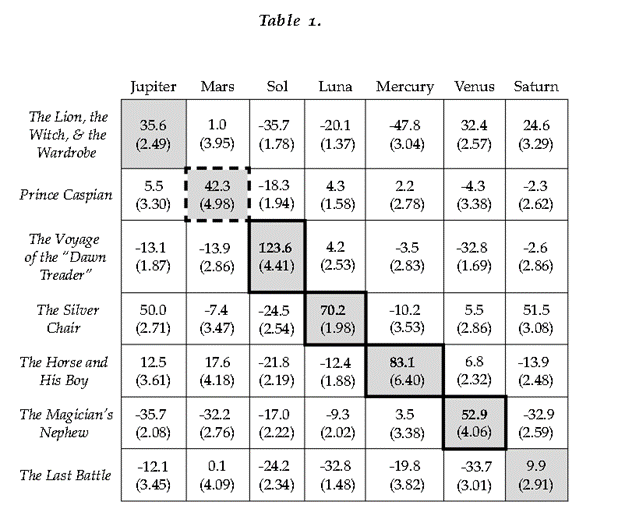
I really like your assignment of “fulfillment” as a theme for this book. I think that is a really good single word to capture what I see in it. Each character is changing from a Calormene worldview, letting go of their unhealthy ways of thinking and embracing the ways of a different kingdom. Each is changed and becomes a true follower of Aslan – and they do live fulfilled lives: the humans in Archenland and the horses in Narnia.
Thus, if I have to assign a Heavenly virtue, I feel ‘charity’ is probably the best, though I feel like “transformation”, “renewal”, “awakening” or “repentance” capture what I feel when I read this book – though even then, I do not feel any of these words capture the contentment or the freedom the characters receive with the change they undergo (unlike fulfillment which does capture those facets).
I think Prince Caspian is the most difficult book to assign a main theme to. C. S. Lewis said that Prince Caspian is about the:
restoration of the true religion after corruption.
I find this interesting, as I see both the restoration of Narnia as a free land - for both the Telmarines and for Narnian creatures - and the restoration of true religion (as in Narnia is re-introduced to Aslan) as taking place over the course of the narrative. Clearly both restorations are related to one another. Kennedy Unthank stated the main themes as:
Prince Caspian depicts the perseverance of faithful Christians despite mockery and persecution. Those who follow Aslan are ridiculed by many of their peers who claim that he’s just a fairy tale. …
This theme likewise develops the idea of forsaking everything to follow Aslan. Prince Caspian flees into the night—abandoning his people and lineage—and becomes a follower of Aslan. Likewise, Lucy (the Pevensie with the most faith) is confronted by Aslan and commanded to follow him, even if none of her siblings will. Lucy ultimately tells her siblings that she’ll have to leave them behind if they won’t join her in following Aslan. …
I would agree that these themes are present in the book – and prominent themes at that. (I essentially was talking about the same this when I made the post above about “Doubt in Prince Caspian”, so I was kinda chuffed to read him say it.) On the other hand, are these the main themes of the book? I am not so sure: if the sections of the book that did not present these themes were removed, I feel like the majority of the story would not disappear. It feels like a part of the picture, but not quite the whole thing.
Michael Ward saw this as the ‘Mars’ story in the series. He notes that Mars themes include war, martial discipline, military strength, courage, trees & vegetative growth, courage & orderliness verses cruelty and lawlessness. I think the themes that Ward presents do show up in the book:
- It is a war story.
- Reepicheap is a heroic knight.
- Peter has a sense of martial discipline in challenging Miraz and how he fights Miraz.
- Martials are chosen to align the edge of the ring in which Peter & Miraz duel.
- Miraz’s army has great military strength, overpowering the old Narnian forces.
- Caspian has to show courage to believe in Aslan when he is mocked by Miraz, Trumpkin, Nikabrik, etc.
- Lucy has to show courage in following Aslan even if others won’t.
- The Pevensies find themselves in Narnia surrounded by overgrown trees.
- Cair Paravel has become overgrown with an orchard.
- Caspian flees, riding on his horse, Destria, through overgrown forests and ultimately hits his head on a tree.
- The Narnians set up camp at Aslan’s Howe near the great forests that the Telmarine’s have allowed to grow up in the East of Narnia.
- The Telmarines fear the forests.
- Trumpkin and the four Pevensies get lost in the forests that are now overgrown making Narnia unrecognisable to them.
- Lucy tries to awake the trees; Aslan succeeds in awakening the trees.
- During the ‘romp’ where Lucy and Susan hang out with Aslan, Silenus, Bacchus and the wild woman, there are vines everywhere. Likewise, as the people in Beruna respond to Aslan (either in love or fear), there are vines everywhere. A man who beats a boy is turned into a tree.
- At the second Battle of Beruna, the war is ended when the trees enter the battle.
- There is the contrast of the courage of the Narnians verses the cruelty of Miraz and the the Telmarines.
Thus, Ward’s thesis seems to me to be somewhat helpful for understanding elements in this book. My difficulty is that, it helps to understand plot elements that occur throughout the book, but it does not supply a ‘theme’ or ‘moral’ in any sort of traditional sense. It may add to the feeling of the book, but it does not help me to make sense of the heart of the story in any great sense. I note also, that in the graph above, apparently a close analysis of this book shows that the themes Ward highlights occur only slightly above the frequency you would expect for a story like this than if they were present merely by coincidence.
Your assignment of “Prudence” has merit. Caspian and co. need to show prudence in how they prepare for war with Miraz. Peter, Edmund, Caspian and Dr. Cornelius show prudence in how they make use of their time while they wait for Aslan to act. Lucy needs prudence in how she follows Aslan, etc.
There does seem to be some importance to ‘history’ in this book. Miraz hides the history of Old Narnia because he does not want to awaken that old hope; his way of oppressing Old Narnia is to force people to forget it. Caspian’s Nurse and Doctor Cornelius inform Caspian of Old Narnia’s history – causing Caspian to be loyal to the old Narnians. Trumpkin refuses to believe the old history until he is forced too – and his lack of belief is a hindrance to his comrades. Nikabrik ultimately lets go of his belief in the goodness of Aslan, questioning the history he had been taught, and tries to resurrect the White Witch.
Faith verses doubt shows up as a theme (as I documented in the thread above). This theme is closely connected with the forgotten/remembered history theme. The faithfulness of each follower is closely tied to how much faith they have in Aslan.
The nature of Kingship is somewhat in focus. Peter is a king, who submits to Aslan’s ultimate Kingship and who uses his authority to put Caspian on the throne. Caspian is the rightful king, who submits to Peter when he meets him and to Aslan when he meets him too. Caspian is humble and knows himself to be only a child and perhaps not ready to be king. Miraz, in contrast, kills the rightful king and refuses to allow his nephew to be king. Miraz refuses to acknowledge either King Peter or Aslan as real persons, thus denying their authority. Miraz’s own counsellors murder him because they are agitated that he used them to make himself king, but did not reward them in any way. Miraz is a lousy ruler who cares only about himself. Miraz is a bad leader, while Peter and Capian are noble leaders.
A part of the difficulty (to me at least) is that the story begins following the four Pevensies during which, I do not notice the story being told from any one character’s point of view. It then switches to a flash back with the story told from Caspian’s point of view. Once we return to the present, the narrative continues being told primarily from Lucy’s point of view as the 4 children and Trumpkin travel to Aslan’s Howe. Upon arriving at Aslan’s Howe, there are two parallel stories, one with Peter as the point-of-view character and the other being more-so from Lucy’s perspective. In other books, I can identify a main character, whose point of view is primarily used to tell the story (E.g., Digory, Lucy & Edmund, Shasta, Jill, Tirian).
In the first section, there are some hints of what I had labelled as the ‘doubt’ theme, but it is not prominent at that point. Beyond that, we are mostly being introduced to the world and the mystery the children are solving as to where they are.
In the second section, I would think the main theme is fidelity to Aslan and Old Narnia that is really in focus. Caspian is first put under pressure by his Uncle Miraz to abandon his belief in Narnia. Both Caspian and Doctor Cornelius need to show courage to stand firm in the midst of their situation. When Caspian finds himself amongst the old Narnians, he again faces the mockery of Trumpkin on the one hand and the temptation to compromise like Nikabrik – whose loyalty is not truly to Aslan, but to whoever will give him (and the dwarfs) what he wants. When Miraz attacks the Narnians and they are losing in their battles, there is again pressure to compromise and not truly follow Aslan.
Once we return to the Pevensies and Trumpkin, Trumpkin’s lack of belief in the old Kings and Queens is initially in focus. Then both Trumpkin’s and Susan’s doubt in Aslan – or doubt that Lucy has really seen Aslan comes to the forefront. Lucy has to courageously follow Aslan even if the others will not follow. Edmund is contrasted with the opposition of Susan.
In the final section, Peter is pictured as an honourable, noble king in contrast to Miraz. Peter and the Narnians behave faithfully with regard to one another and in how they negotiate with the Telmarines, while the Telmarines betray one another and go back on their promise to the Narnians when Miraz is killed.
In Beruna, A second battle is being waged by Aslan and the girls; in this battle they disarm the Telmarine populace as the Telmarines learn that Aslan and Old Narnia are real. We learn that there are both good and bad people, who each respond to Aslan.
I am not sure how to summarize all this into a single, succinct theme. Faithfulness / trust / courage seem to be the best words to summarize the main theme with a single word. Given I used “Trust” as the theme for The Magician’s Nephew (which is basically a synonym for “Faith”), I guess, I will assign “Courage” as the single word theme for this book.
This post was modified 1 month ago 2 times by DavidD
The term is over: the holidays have begun.
The dream is ended: this is the morning
Topic starter
Posted : March 31, 2026 4:45 pm
waggawerewolf27 liked
@davidd Shasta has been raised as a peasant, but was really treated as a slave by the man who he thought was his father and was going to be sold into slavery to Bree’s Tarkaan.
Yes, that is true and emphasizes what C.S Lewis says about "the calling and conversion of a heathen", the theme he allots to this book. And I do agree with you that all four of the travellers on that quest to escape Calormen's civilization could be considered "pagans". And that all four of the travellers, working together, contribute to the eventual fulfilment of a prophecy made when Shasta, the stolen heir to the Archenlandish throne, was born, as below.
"Well, as soon as he saw Corin and me, it seems this Centaur looked at me and said, 'A day will come when that boy will save Archenland from the deadliest danger in which ever she lay'. So, of course my Father and Mother were very pleased. But there was someone present, who wasn't. This was a chap called the Lord Bar who had been Father's Lord Chancellor. And apparently, he had done something wrong...and Father had had to dismiss him... it came out afterwards that he had been in the pay of the Tisroc, & had sent a lot of information to Tashbaan. So... he decided I must be put out of the way".
The reason I chose "fulfilment" as a theme not only for HHB but also for the last published book of the Harry Potter series, (Deathly Hallows) was due to a prophecy made about Voldemort, the chief villain, as below.
-
The one with the power to vanquish the Dark Lord approaches... born to those who have thrice defied him, born as the seventh month dies... and the Dark Lord will mark him as his equal, but he will have power the Dark Lord knows not... and either must die at the hand of the other for neither can live while the other survives... the one with the power to vanquish the Dark Lord will be born as the seventh month dies...."
— Sybill Trelawney's prophecy made to Albus Dumbledore
It is only when Harry returns to Hogwarts, along with his friends, having endured a year as outcasts, that he is eventually ready to face Voldemort, according to the prophecy, to defeat him, thus removing that particular evil. Voldemort killed Harry's Parents, even though he failed to kill 18-month-old Harry, himself. That is how Harry came to live with his Aunt Petunia, where he was treated as a second-class citizen, compared to his spoiled cousin, Dudley Dursley. Now, themes of pride & humility (the remedial & opposite virtue) run right through the HP series, especially when Severus Snape frequently accuses Harry of arrogance & "strutting like his proud father", seeing only James Potter, one of the four Marauders of Prisoner of Azkaban, where we learn, not only about the DADA teacher, Remus Lupin, & his lifelong werewolf disability, but also about Sirius Black, the third marauder, accused wrongly of betraying the Potter family to Voldemort. Now, isn't it strange that there were four marauders, in that book, just like there were four siblings in the Pevensie family to fill the four thrones of Cair Paravel, in a third Prophecy, which we saw in LWW (p.76) as below?
When Adam's flesh and Adam's bone
Sits at Cair Paravel in throne,
The evil time will be done and over.
And now, there are four travellers to Narnia, in HHB. Hwin, who comes across as the humblest of the four, isn't asserting herself against Aravis, her owner, but whose care and affection for her is most evident, especially when she literally saved Aravis' life. She can't assert herself against Bree's warhorse pride, yet, when the chips were down, she set the pace to cross the mountains & a few times was more of a leader in some ways than was Bree, himself. Shasta seems to be trying to show that he isn't quite the "loser" & "slave" Aravis might consider him as being, usually failing miserably.
However, when Shasta meets his own father, saying: 'I'd be just as pleased - or very nearly - of finding that he is my father, even if he wasn't a king - even though Education and all sorts of horrible things are going to happen to me'.. I have to think hard about why it is Shasta, the former slave, who is going to be king and not Corin, who, despite his impulsive behaviour at Tashbaan, has presumably had at least as much 'Education' as Aravis & the later Prince Caspian, and is likely to parade what he achieved, much like Aravis, herself, at times. It is just as well that Corin cheers to be let out of the responsibility, concluding that "princes have all the fun".
Critics of C.S. Lewis, like Philip Pullman, like to accuse him of racism because of his depiction of Calormen, in HHB, and the sore topic of slavery in that book. However, slavery goes back to Ancient Egyptian times when prisoners-of-war were originally the greatest source of slaves, as shown by not only the Bible, but also Greek stories like the Iliad or the Odyssey and yes, the Romans were famous for it as well. At Christmas in 2024, I read Peter Frankopan's The Silk Roads: a new history of the world, in which he discusses the trade along Marco Polo's famous Silk Road, who was in China with Kublai Khan round about 1288, from earliest times to a decade ago. It wasn't only silk textiles, silver & gold, 20th century petroleum, or furs and other luxury products that were traded: when nothing else was available, slaves were traded as well. And somewhere, Francopan said in his book, that regardless of whether the traders were Zoroastrian, Jewish, Muslim or Christian, or merely the usual sort who would "sell their grandmothers for personal gain", they all behaved just as badly as each other at one time or the other. That was even before the Ottoman Empire's successful siege of Constantinople on 29th May in 1453, brought the Byzantine Empire to an end, and closing off Silk Road trade, thus impelling Western European nations, like Spain & Portugal, to explore sea routes to outflank the Ottoman & Arab monopoly blocking European trade, finally achieved in 1488, when Portuguese captain, Bartolomeo Diaz, rounded the Cape of Good Hope at the tip of South Africa.
In your excellent exploration of HHB & of what it means to be a slave, would you consider that slavery also just might be an overarching topic for the whole Narnia series? In LWW with the dictatorially petrifying White Witch in charge, enslaving the Narnians to her will, it is to her a matter of justice, & therefore also injustice, when resentful grievance causes Edmund to betray Lucy & Mr Tumnus, in particular. In contrast, it was a distinct lack of courage, that induces Peter Pettigrew, the fourth marauder, to commit the betrayal that Sirius Black was unjustly blamed & imprisoned for, in HP's POA.
What about the other 5 books of the Narnian series? Yes, HHB continues on as part of LWW, where at the end, we learn of Susan the Gentle, Peter the Magnificent, Edmund the Just and Lucy the Valiant, just as you have pointed out. Some have seen these four sovereigns as representative of the four Cardinal Virtues, which, with the Theological Virtues, make up the Seven Heavenly Virtues, quoted below.
All four, having completed their stay in Narnia, then go back through the Wardrobe, only to return later, having become children again, where they are to help Prince Caspian regain his throne. So, given his loneliness, brought up in Miraz's castle, a theme of Friendship might also be appropriate for that book, especially when he is obliged to seek the Friendship of the Old Narnians.
When I did those tables, to examine the Seven Deadly Sins, it was the Seven Heavenly Virtues that were mostly looked at, but what about the 7 Opposing Virtues, both sets of which are defined below by Wikipedia?
In Christian history, the seven heavenly virtues combine the four cardinal virtues of prudence, justice, temperance, and fortitude with the three theological virtues of faith, hope, and charity.
The seven capital virtues, also known as seven lively virtues, contrary or remedial virtues, are those opposite to the seven deadly sins. They are often enumerated as chastity, temperance, charity, diligence, kindness, patience, and humility.
Your lovely, nicely set out, table from Michael Ward suggests ratios and percentages, which doesn't say much at all, I agree, when despite the hierarchical Dewey Decimal System, mathematics, even when applied to interesting planets, isn't really my forte.  I'm sorry, but I don't understand what Michael Ward was really getting at, preferring your other references to Dr King and Kennedy Unthank. Even the Wikipedia definitions tend to be a bit repetitive, when opposing the Seven Deadly Sins & when charity also can mean either mercy or kindness, when temperance means moderation, & when fortitude can mean courage, but also means the strength to endure & persevere, another word for diligence, like Trufflehunter the Badger, in PC. Unfortunately, PC's werewolf, brought by Nikabrik to that Aslan's Howe council also claims to endure & to persevere, "to keep on, keeping on".
And then there is chastity, which opposes the usual Deadly Sin of Lust, for the opportunistically profiteer Miraz, but how does that work for Queen Prunaprismia, giving birth to Miraz' son, or Lord Bern, the Missing Lord, the first to abandon his shipmates to marry a girl & settle down with a family? Thankfully, there is another term called fidelity, which, unlike faith (or trust), is defined by Merriam-Webster as the application of loyalty, which fits Lucy to a T when she is the first to see Aslan, and when he expects her to follow him regardless of what her siblings desire to do. It is not enough to have faith in God; one needs to be faithful in that service as well. Not something that can be said of either PC's Miraz, or his friends, Sopespian & Glozelle, let alone his likely Lone Island appointee, Governor Gumpas, allowing a brisk traffic in slavery & whom we meet in VDT.
@davidd Michael Ward saw this as the ‘Mars’ story in the series. He notes that Mars themes include war, martial discipline, military strength, courage, trees & vegetative growth, courage & orderliness verses cruelty and lawlessness. I think the themes that Ward presents do show up in the book:.... it is a war story..
Maybe so, but in any battle, there are at least two sides, and one must choose friends & allies carefully, especially as this conflict broke out with Prince Caspian fleeing Miraz's castle as a "wanted" outcast, having prudently realised that his cousin's birth would put his own life at risk. When Prince Caspian becomes the guest of two dwarves and a badger, the welcome is decidedly mixed. The only one who accepts him unhesitatingly is Trufflehunter. When Prince Caspian has been brought up by Miraz to see the natives of Narnia as somewhat mythical & therefore, unimportant, these native creatures have no reason to trust his Telmarine origins, and Trumpkin, like Nikabrik, is suspicious of the likes of Caspian's tutor, the learned Dr Cornelius, whose people have blended in with the Telmarines, and his teaching Caspian those old tales of the past. Nikabrik, like the Tisroc in HHB, sees more reality & power in the White Witch's long winter. And as Kennedy Unthank points out:
In other words, not every character in Narnia is meant to depict a Christian truth despite those truths being present in the writing. Now, Aslan certainly represents the Son of God, as Lewis makes clear in his letters. Christian ideas and themes are expounded upon in several books (which we’ll dive into below). But other characters, like the aforementioned satyrs and river gods, aren’t meant to have one-to-one comparisons. They simply are. Though they may be mythological in our world, they are real in Narnia. And they still need saving.
The same principle that they just are, also applies to Nikabrik & friends at that Aslan's Howe council, where Dr Cornelius, himself, Caspian and Trufflehunter find themselves pitted against Nikabrik, & his friends the Hag and the Werewolf, who have allegedly survived the purge of the White Witch's army of supporters at the first Battle of Beruna. When Trumpkin arrives with Peter and Edmund, Nikabrik and his friends are killed, but not before the werewolf has bitten Caspian, an injury, which would rule him out of any immediate confrontation, & according to all that we know about werewolves elsewhere in literature, including in JKR's "Chamber of Secrets" & POA, might well leave him with a lifelong disability, not unlike real-life Rabies or Lyssa virus.
Pitted against Miraz's own army Caspian had lost miserably, and they are just lucky that most of the Narnians had been able to retreat back into Aslan's Howe. There, Prince Caspian had blown Queen Susan's horn, a treasured iconic memento of their Narnian reign. But what sort of help is he calling for, and will that help materialise? Trumpkin, sceptically practical, himself, dispatched to Cair Paravel, took some convincing that "Once a king or queen of Narnia, always a king of Narnia", when that help arrived in the form of four schoolchildren, the eldest about the same age as Prince Caspian, himself. And there are doubts amongst the Pevensies, themselves. Queen Susan the Gentle, who shot the arrow which freed Trumpkin from his capture, never was a warrior despite her depiction in the film of this movie, & wasn't really interested in competitions or in hurting animals, even when necessary, is likely the least committed to render any such assistance to Caspian, though she rows the boat and co-operates in their journey.
Was it merely prudence for Susan, disbelieving of Lucy in LWW, to be as cautious & uninvolved as she seems to be in this second Narnian episode? Or was it a lack of courage? When Aslan commands Lucy to follow him no matter what her siblings decide, this was not just a test of Lucy's own commitment to Aslan, but also that of her siblings. King Edmund the Just is the first to recognise Aslan leading them: although he had been just as grouchy as the rest of the party, he had been also determined to believe Lucy, this time, to make up for his previous behaviour. Peter sees Aslan next, later magnanimously apologising for leading them all wrong. Whilst Susan brings up the rear, confessing to Lucy her fears. Whilst Trumpkin the dwarf was playfully reminded, like Bree in HHB, that Aslan was real.
This post is already too long to show how Chamber of Secrets shares the same themes of virtues & vices as does Prince Caspian, & how both the Missing Lord, Lord Rhoop, shattered by the nightmarish Dark Island, and COS's DADA teacher, Gilderoy Lockhart's, committing a real-life publishing crime by stealing other people's memories to boost his Indiana Jones-like vision of himself. So, I'll leave it for the moment.
This post was modified 1 month ago 15 times by waggawerewolf27
Posted : March 31, 2026 8:51 pm
DavidD liked
And that all four of the travellers, working together, contribute to the eventual fulfilment of a prophecy made when Shasta, the stolen heir to the Archenlandish throne, was born, as below.
Ohhh, I see, that is quite different to what I was thinking when I read the word ‘fulfilment’ in your original table. If I understand you correctly, you are using ‘fulfilment’ in a similar manner to how Kennedy Unthank’s use of ‘sovereignty’ where he says the book is about God’s sovereignty (I.e. there is a prophesy that is going to happen regardless of the obstacles).
Shasta seems to be trying to show that he isn't quite the "loser" & "slave" Aravis might consider him as being, usually failing miserably. ... I have to think hard about why it is Shasta, the former slave, who is going to be king and not Corin, who, despite his impulsive behaviour at Tashbaan, has presumably had at least as much 'Education' as Aravis & the later Prince Caspian, and is likely to parade what he achieved, much like Aravis, herself, at times.
Yes, that’s true, Shasta’s hardships likely allowed him to be a humble king, remembering his own past.
... would you consider that slavery also just might be an overarching topic for the whole Narnia series?
I certainly think it is a theme that shows up in many of the books. I think it the slavery most prominent in The Horse and His Boy (and in the ‘Lone Islands’ section of The Voyage of the Dawntreader). Elsewhere, Lewis consistently shows slavery to be a bad thing. (Jadis is demonstrated as a thoroughly evil individual, who is pro-slavery in The Magician’s Nephew, Jadis implicitly enslaves all Narnia in The Lion, the Witch and the Wardrobe, Rillian is enslaved by the Lady of the Green Kirtle and the Colormenes are enslaving the Narnians in The Last Battle). I would not say it is an ‘overarching theme’ in that while it is a theme that is present throughout the chronicles, slavery is not usually the focal point thematically in the books. It is certainly present though.
So, given his loneliness, brought up in Miraz's castle, a theme of Friendship might also be appropriate for that book, especially when he is obliged to seek the Friendship of the Old Narnians.
The Pevensies also befriend Trumpkin. Aslan almost forces Trumpkin to be his friend. Dr. Cornelius is a very good friend to Caspian. I think “Fidelity” may describe what I see as the theme more so than “friendship” because we see how disloyal Miraz is to his nephew and how Miraz’s own Lords betray him in an act of betrayal. This would contrast directly to reliability of Peter and Caspian with regard to one another along with the Narnians to Caspian and vice versa. But I am probably playing with words too much and ‘friendship’ is certainly a good word to describe much the same thing.
The term is over: the holidays have begun.
The dream is ended: this is the morning
Topic starter
Posted : April 2, 2026 7:38 pm
waggawerewolf27 liked
@davidd If I understand you correctly, you are using ‘fulfilment’ in a similar manner to how Kennedy Unthank’s use of ‘sovereignty’ where he says the book is about God’s sovereignty (I.e. there is a prophesy that is going to happen regardless of the obstacles).
That is right, or put it in another way, no matter how much the likes of Jadis the White Witch, knowing about the prophecy of the 4 thrones in Cair Paravel, likes to try to wriggle out of it, the more it is likely to take place. That is just as true of Voldemort, the villain of J.K. Rowling's fictitious HP series as it is true of the White Witch of Narnia, in C.S. Lewis' equally fictitious supposal, to make Christ's crucifixion & resurrection more understandable for young readers. In LWW, I put the theme as Discipline, or more correctly, self-discipline or abstinence, in opposition to excess, or gluttony. Justice would be the Heavenly virtue, and the same applies in Prisoner of Azkaban, though it is more about social Justice rather than the spiritual Justice of LWW, where Aslan is put to death by the White Witch in place of Edmund, whom she thinks is her lawful prey, and whose death would destroy the prophecy she hoped to thwart. The equivalent Missing Lord is Mavramorn, quietly enjoying a meal at Aslan's Table.
@davidd I would not say it is an ‘overarching theme’ in that while it is a theme that is present throughout the chronicles, slavery is not usually the focal point thematically in the books. It is certainly present though
You might say the same about Education as a theme, though C.S. Lewis said plenty about it, in just about all the books, excepting the last two, MN & LB. In LWW, he has the Professor asking; "Why don't they teach logic at these schools"? or, "What do they teach them at these schools"? There is Eustace and his journal, as well as Susan & Peter's whereabouts, in VDT, the bullying in Experiment House in SC, whilst in HHB, we learn about Calormene education, & Shasta's dread of what he is in for as a prince. But in PC, the second book, we learn heaps about Caspian's education, first with his Nanny, then with Dr Cornelius. And in the Romp at the end, there are other examples of what Telmarine education might be like.
Now, the HP books are all set in a boarding school, somewhere in the wilds of UK, rather in a different dimension or spiritual world, like Narnia, so Education is a given theme in a setting which includes much the same creatures as you see in Narnia, such as Dragons, Centaurs, Unicorns, and more. As was said in Kennedy Unthank’s long & very useful post, such creatures just are, including giants, werewolves, hags etc, though unlike C.S Lewis' use of classical creatures of fauns, satyrs, naiads, dryads, river gods, etc, Rowling turns more to UK's own extensive folklore, such as kelpies, in the Scottish sense, at Falkirk's famous Wheel, rather than a type of Australian cattle dog, whilst some nasties are her own invention. To compare & contrast two otherwise entirely different series, I drew up a table which I've now altered to make it more applicable to the publishing order of the Narnia Chronicles, and this is what I found:
|
Book |
Theme |
Missing Lord |
Virtues |
Sin |
DADA Teacher |
|
|
LWW |
Discipline |
Mavramorn |
Justice Abstinence |
Gluttony |
Remus Lupin POA |
|
|
PC |
Friendship |
Rhoop |
Prudence Fidelity |
Lust |
Gilderoy Lockhart COS |
|
|
VDT |
Discovery |
Octesian |
Temperance Liberality |
Greed |
Quirrell PS/LB
|
|
|
SC |
Service |
Bern |
Hope Diligence |
Sloth |
Snape HBP |
|
|
HHB |
Fulfilment |
Restimar |
Charity Humility |
Pride |
Amycus Carrow DH |
|
|
MN |
Authority |
Argoz/Revilian (Stone knife) |
Faith Patience |
Anger |
Umbridge OOTP |
|
|
LB |
Competition |
Revilian/Argoz Return to Narnia |
Courage Kindness |
Envy |
Moody GOF |
|
It completely reverses the order of the first three HP books, leaving both Prince Caspian & Chamber of Secrets in the same second place. The first book in this table, for HP, like LWW, about Justice and abstinence or Restraint, in opposition to Gluttony, is Prisoner of Azkaban, about the wrongly incarcerated member of the Marauders, one of four school friends, who clubbed together to protect one of their own from getting into trouble every full moon. This is also the book where Voldemort's portentous prophecy is first aired, when it deals with the back-story of the Prisoner of Azkaban, & how a strong friendship between four schoolboys had come to grief.
Harry Potter's deceased father was Prongs, when his animagus form was a stag, whilst the wrongly imprisoned Sirius Black, turned himself into a large Black Dog, calling himself "Padfoot". Peter Pettigrew, the 4th, turned into a rat, called Wormtail, the complete opposite of the noble, talented & valiant Mouse, Reepicheep, of VDT & PC. No prizes for guessing that he was the culprit who later "ratted" to Voldemort the whereabouts of Harry's parents, not Sirius Black, who had escaped from prison. Whilst with his 3 friends, "Moony", suffering these Full Moon werewolf episodes, could be controlled from doing any harm. And when Moony AKA Remus Lupin becomes the DADA teacher, Severus Snape, who'd been snooping on this band of Marauders when they were all young students, makes him a potion enabling Remus Lupin to curl up in his office to sleep off the effects of his disability, even taking his DADA classes for him at that time. Though Lupin was otherwise a popular and effective teacher, when he forgot to take his medicine, due to the exciting events of the story, he ended up losing the job.
I've already explained what happened to COS' DADA teacher, Gilderoy Lockhart, earlier in the thread. This would-be Bob Irwin of the Magical World who had been stealing other people's memories to pass off as his own, wrote 7 books, including Wandering with Werewolves & Holidaying with Hags, reminders of Nikabrik's friends at Aslan's Howe. When he was strangely inept in controlling pixies in class, he resorted to class readings from these books, & when he was finally unmasked, he accidentally wiped out his own memory. On 14th February, of course, it was Lockhart's idea to hold such romantic festivities, despite the embarrassment of some of these 12-year-old boys, like Harry.
The second-hand diary given to Ginny, Ron's sister, also suggests Lust as a theme for this book, when she uses it to confide in, when as the sole girl in a family of six older brothers, she was often lonely, especially when her 3rd brother was one of the prefects, and she & Ron's older twin brothers, never seemed to take anything seriously. However, the diary wrote back, like an Internet troll. It used to belong to an old school student, one Tom Marvolo Riddle, considered so brave, with top grades in his exams, a former head boy and oh so brilliant. The future Voldemort had literally poured his soul and some very dark secrets, indeed, into that diary, a much darker person than people at the time realised, suggesting that despite his academic achievements, once he left school, he was bound to come to no good. But when Ginny is mesmerised into daubing messages on school walls, and when a basilisk is released from the Chamber of Secrets, to terrorise other students, with a Medusa-like, petrifying stare, it leads to a deadly confrontation there, resolved finally when Harry, concerned for the welfare of his best friend's sister, abducted by the diary's revenant, stabs it with the fabled Sword of Justice, normally kept in Dumbledore's office.
Tom Riddle's patricidal secrets & memories were every bit as dark & nightmarish as anything Missing Lord, Rhoop, would likely find on Dark Island. Rhoop, also, was lured into following his heart's desire, only finding nightmares, instead, as he warned the crew of the Dawn Treader. No wonder he was a broken man, and it was only Aslan's intervention that rid Narnia of that soul-destroying destination, to enable the Dawn Treader to escape, allowing Lord Rhoop to join his shipmates to dreamlessly sleep in forgiving peace.
But though Lockhart's performance as DADA teacher, well matches Dr King's view of King Miraz as a profiteer, and though originally, I first considered Lord Bern to be the Missing Lord, because of Pug and Governor Gumpas, Dr King, I think it was, pointed out that Lord Bern was the first of the seven Missing Lords to abandon their mission, to marry and settle in the Lone Islands, so Sloth, for abandoning them, would be a more reasonable failing. Even more so, when his perseverance in opposing Gumpas' slave trade is paid off when the slave he bought was the son of the King Caspian who had originally commanded his loyalty and service. Dr King, like me, also considers the one of the three sleepers as being a good symbol of anger when he picked up the White Witch's iconic stone knife. The trouble is, I thought that Missing Lord was Argoz, but Dr King thought it was Revilian. When the two men were vying with each other with opposing arguments, and when one wanted to go home to Narnia, anger and envy, perhaps of Lord Bern who abandoned their quest first, might well have been someone to envy for the loser in that Aslan Table's argument.
This post was modified 1 month ago 8 times by waggawerewolf27
Posted : April 6, 2026 9:52 pm
DavidD liked
You might say the same about Education as a theme, though C.S. Lewis said plenty about it, in just about all the books, excepting the last two, MN & LB. In LWW, he has the Professor asking; "Why don't they teach logic at these schools"? or, "What do they teach them at these schools"? There is Eustace and his journal, as well as Susan & Peter's whereabouts, in VDT, the bullying in Experiment House in SC, whilst in HHB, we learn about Calormene education, & Shasta's dread of what he is in for as a prince.
I wonder how much of this was related to Lewis’ own education. He did not enjoy public schooling. His time at Wynyard School involved being terrorised by the school’s violent headmaster. He also did not enjoy his time at Malvern College either. He was much happier receiving personal tutelage from William Kirkpatrick. In the Chronicles of Narnia, Private tutors are often represented favourably:
- Caspian receives positive education from Dr Cornelius, his private tutor,
- Peter receives private tuition from old Professor Kirke (whose name is remarkably similar to that of W. T. Kirkpatrick) during the events of ‘The Voyage of the Dawn Treader’.
Schools do not fare so well:
- Edmund is initially corrupted by his school. Peter comments
…You’ve always liked being beastly to anyone smaller than yourself; we’ve seen that at school before now.
Later Lewis comments that Edmund becomes a more honest person than he had been in ages - “ever since his first term at that horrid school which was where he had begun to go wrong.”
(Again, many people notice that Lewis lost his faith as a child while attending what he considered to be a ‘horrid’ school.)
- As you pointed out the professor constantly wonders “what they teach kids at these schools”.
- Experiment house is not presented as the best school ever made:
These people had the idea that boys and girls should be allowed to do what they liked. And unfortunately what ten or fifteen of the biggest boys and girls liked best was bullying the others. All sorts of things, horrid things, went on which at an ordinary school would have been found out and stopped in half a term; but at this school they weren’t.
Again, Lewis own time at Malvern College was not a positive experience. Lewis did not like the manner in which the elder students forced younger students to ‘f*g’ for them (i.e., do chores like clean the older children’s boots). Lewis wrote pretty harshly about this school in Surprised by Joy.
It could be that Lewis had very different reasons for the strong views he expressed about schooling in the books, but I do wonder if his own negative experience of the British schooling systems is a factor in what he wrote.
C.S. Lewis said “The Voyage of the Dawn Treader” is about
…the spiritual life (specially in Reepicheep).
I find this statement both helpful and confusing. The first half of this sentence makes perfect sense to me, as the characters have a number of episodes throughout the book (with a different character’s point-of-view presented in each episode). In each episode, the character is often tempted / tested and grows through the experience – with Aslan usually delivering the person to some degree. Thus, the theme of ‘the spiritual life’ sums up this book very well.
‘Especially Reepicheep’ on the other hand does not help me much at all. Reepicheep is never the point-of-view, main character in any of these episodes.
Reepicheep has a conflict early in the story with Eustace.
"Ugh, take it away," wailed Eustace. "I hate mice. And I never could bear performing animals. They're silly and vulgar and — and senti mental."
"Am I to understand," said Reepicheep to Lucy after a long stare at Eustace, "that this singularly discourteous person is under your Majesty's protection? Because, if not — "
Anyway, as soon as he saw that long tail hanging down — and perhaps it was rather tempting — he thought it would be delightful to catch hold of it, swing Reepicheep round by it once or twice upside-down, then run away and laugh. At first the plan seemed to work beautifully. The Mouse was not much heavier than a very large cat. Eustace had him off the rail in a trice and very silly he looked (thought Eustace) with his little limbs all splayed out and his mouth open. But unfortunately Reepicheep, who had fought for his life many a time, never lost his head even for a moment. Nor his skill. It is not very easy to draw one's sword when one is swinging round in the air by one's tail, but he did. And the next thing Eustace knew was two agonising jabs in his hand which made him let go of the tail; and the next thing after that was that the Mouse had picked itself up again as if it were a ball bouncing off the deck, and there it was facing him, and a horrid long, bright, sharp thing like a skewer was waving to and fro within an inch of his stomach. (This doesn't count as below the belt for mice in Narnia because they can hardly be expected to reach higher.)
"Stop it," spluttered Eustace, "go away. Put that thing away. It's not safe. Stop it, I say. I'll tell Caspian. I'll have you muzzled and tied up."
"Why do you not draw your own sword, poltroon!" cheeped the Mouse. "Draw and fight or I'll beat you black and blue with the flat." "I haven't got one," said Eustace. "I'm a pacifist. I don't believe in fighting."
"Do I understand," said Reepicheep, withdrawing his sword for a moment and speaking very sternly, "that you do not intend to give me satisfaction?"
Despite Reepicheep’s dislike of Eustace, he refuses to abandon Eustace when Rinse implies that the heroes are better off without him:
"But we must do something," said Lucy. "He may have got lost, or fallen into a hole, or been captured by savages."
"Or killed by wild beasts," said Drinian.
"And a good riddance if he has, I say," muttered Rhince.
"Master Rhince," said Reepicheep, "you never spoke a word that became you less. The creature is no friend of mine but he is of the Queen's blood, and while he is one of our fellowship it concerns our honour to find him and to avenge him if he is dead."
Reepicheep shows compassion for Eustace when Eustace is a dragon.
On the evenings when he was not being used as a hot-water bottle he would slink away from the camp and lie curled up like a snake between the wood and the water. On such occasions, greatly to his surprise, Reepicheep was his most constant comforter. The noble Mouse would creep away from the merry circle at the camp-fire and sit down by the dragon's head, well to the windward to be out of the way of his smoky breath. There he would explain that what had happened to Eustace was a striking illustration of the turn of Fortune's wheel, and that if he had Eustace at his own house in Narnia (it was really a hole not a house and the dragon's head, let alone his body, would not have fitted in) he could show him more than a hundred examples of emperors, kings, dukes, knights, poets, lovers, astronomers, philosophers, and magicians, who had fallen from prosperity into the most distressing circumstances, and of whom many had recovered and lived happily ever afterwards. It did not, perhaps, seem so very comforting at the time, but it was kindly meant and Eustace never forgot it.
Upon encountering the Sea Serpent, Reepicheep is the one who points out that it is no use attacking the Sea Serpent, but rather the whole crew needs to work together to push the serpent away:
Others would have joined him if at that moment Reepicheep had not called out, "Don't fight! Push!"
…
The brute had made a loop of itself round the Dawn Treader and was beginning to draw the loop tight. When it got quite tight — snap! — there would be floating matchwood where the ship had been and it could pick them out of the water one by one. Their only chance was to push the loop backward till it slid over the stern; or else (to put the same thing another way) to push the ship forward out of the loop.
Reepicheep alone had, of course, no more chance of doing this than of lifting up a cathedral, but he had nearly killed himself with trying before others shoved him aside. Very soon the whole ship's company except Lucy and the Mouse (which was fainting) was in two long lines along the two bulwarks, each man's chest to the back of the man in front, so that the weight of the whole line was in the last man, pushing for their lives.
Reepicheep is again the voice of reason (and courage) on the island of the Duffers. He repeatedly informs the company that they cannot avoid the fate the invisible Duffers force upon them and calls them to bravely face it:
"Your Majesties all," said Reepicheep, "hear me. It is folly to think of avoiding an invisible enemy by any amount of creeping and skulking. If these creatures mean to bring us to battle, be sure they will succeed. And whatever comes of it I'd sooner meet them face to face than be caught by the tail."
"Her Majesty is in the right," said Reepicheep. "If we had any assurance of saving her by battle, our duty would be very plain. It appears to me that we have none. And the service they ask of her is in no way contrary to her Majesty's honour, but a noble and heroical act. If the Queen's heart moves her to risk the magician, I will not speak against it."
It is Reepicheep who succeeds where Lucy could not of convincing the Dufflepuds that being a monopod really isn’t that bad. He does this by being empathetic and helping them to focus on what is good in their lot:
When they reached the bay, Reepicheep had a brilliant idea. He had his little coracle lowered and paddled himself about in it till the Monopods were thoroughly interested. He then stood up in it and said, "Worthy and intelligent Monopods, you do not need boats. Each of you has a foot that will do instead. Just jump as lightly as you can on the water and see what happens."
The Chief Monopod hung back and warned the others that they'd find the water powerful wet, but one or two of the younger ones tried it almost at once; and then a few others followed their example, and at last the whole lot did the same. It worked perfectly. The huge single foot of a Monopod acted as a natural raft or boat, and when Reepicheep had taught them how to cut rude paddles for themselves, they all paddled about the bay and round the Dawn Treader, looking for all the world like a fleet of little canoes with a fat dwarf standing up in the extreme stern of each. And they had races, and bottles of wine were lowered down to them from the ship as prizes, and the sailors stood leaning over the ship's sides and laughed till their own sides ached.
If not for Reepicheep, the Dawn Treader’s crew would not have sailed into the Dark Island and found the Lord Rhoop (neither would they have been endangered by the nightmares of this island):
… But all at once the clear voice of Reepicheep broke in upon the silence.
"And why not?" he said. "Will someone explain to me why not."
No one was anxious to explain, so Reepicheep continued:
"If I were addressing peasants or slaves," he said, "I might suppose that this suggestion proceeded from cowardice. But I hope it will never be told in Narnia that a company of noble and royal persons in the flower of their age turned tail because they were afraid of the dark."
"But what manner of use would it be ploughing through that black ness?" asked Drinian.
"Use?" replied Reepicheep. "Use, Captain? If by use you mean filling our bellies or our purses, I confess it will be no use at all. So far as I know we did not set sail to look for things useful but to seek honour and adventures. And here is as great an adventure as ever I heard of, and here, if we turn back, no little impeachment of all our honours."
Reepicheep is the one who will fulfill the quest’s requirement of going as far as he can to the world’s end. Reepicheep knows that he may well be going to his death, but he desires it nonetheless (as he believes it is his life’s calling:
"Sir," said Caspian, "will you tell us how to undo the enchantment which holds these three Narnian Lords asleep."
"I will gladly tell you that, my son," said the Old Man. "To break this enchantment you must sail to the World's End, or as near as you can come to it, and you must come back having left at least one of your company behind."
"And what is to happen to that one?" asked Reepicheep.
"He must go on into the utter east and never return into the world."
"That is my heart's desire," said Reepicheep.
And Reepicheep fulfils his quest – perhaps with fear, but nonetheless boldly and with great courage. As one person on the internet put it, “He ends his journey joyfully”:
No one in that boat doubted that they were seeing beyond the End of the World into Aslan's country.
…
"This," said Reepicheep, "is where I go on alone."
They did not even try to stop him, for everything now felt as if it had been fated or had happened before. They helped him to lower his little coracle. Then he took off his sword ("I shall need it no more," he said) and flung it far away across the lilied sea. Where it fell it stood upright with the hilt above the surface. Then he bade them good-bye, trying to be sad for their sakes; but he was quivering with happiness. Lucy, for the first and last time, did what she had always wanted to do, taking him in her arms and caressing him. Then hastily he got into his coracle and took his paddle, and the current caught it and away he went, very black against the lilies. But no lilies grew on the wave; it was a smooth green slope. The coracle went more and more quickly, and beautifully it rushed up the wave's side. For one split second they saw its shape and Reepicheep's on the very top. Then it vanished, and since that moment no one can truly claim to have seen Reepicheep the Mouse. But my belief is that he came safe to Aslan's country and is alive there to this day.
Thus, Reepicheep is indeed characterised as one living ‘the spiritual life’. But, for myself at least, it is striking that Reepicheep is never the main character in any of the Dawn Treader’s episodes. The book’s introduction is mostly told from Lucy’s perspective (until Eustace’s diary takes over). The events on the Lone Islands are mostly told from Caspian’s perspective. The events of the storm and Dragon Island are largely told from Eustace’s perspective. On the island of the Duffers, Lucy’s perspective is key. During the dark island, several perspectives are shown, though Caspian’s, Edmund’s and Lucy’s are the audience’s main views into the scene. And in the voyage past Ramandu’s Island, it is again Lucy’s perspective that dominates the story. Reepicheep is always a secondary character in each narrative. Maybe, this just shows that I completely miss Lewis’s point in this story. I am far more impressed in how the other characters engage with temptation and how Aslan helps them to overcome it as revealing the nature of ‘the Spiritual life’ in this story.
Kennedy Unthank thinks that Aslan is depicting the Holy Spirit in this book; convicting and comforting and protecting them from falling into sin. He also sees Eustace’s subplot as demonstrating justification and sanctification:
King Caspian, Edmund and Lucy all face temptations that nearly cause them to forsake each other. Caspian and Edmund nearly come to blows on an island that turns things to gold, and Lucy nearly casts a dangerous but alluring spell. However, in each instance, Aslan appears, protecting them from falling into sin. And when their ship becomes lost in a land of nightmares, Lucy calls on Aslan to help them, and he leads them out of the darkness and into the daylight.
Dr. Don W. King saw this book as related to greed. Although the only example he relates this theme to is Eustace and Dragon Island. I thought he could easily include Deathwater Island in this same assessment.
Similarly, in Planet Narnia, Dr Michael Ward presents a surprisingly similar thesis to that of Dr King (though this time with more detail). Michael Ward sees this as the “Sunna (sun) / Sol / Apollo / Helios” story in the Narniad. I think this is the strongest of his claims as once you remove the ‘sun’ related elements from this story, there is not a whole lot left over:
The voyage constitutes of travelling eastward. The journey east naturally involves travelling towards the rising sun (treading the way to the dawn – as the name “Dawn Treader” implies):
"Right. Well, on my coronation day, with Aslan's approval, I swore an oath that, if once I established peace in Narnia, I would sail east myself for a year and a day to find my father's friends or to learn of their deaths and avenge them if I could ...
"…Why should we not come to the very eastern end of the world? And what might we find there? I expect to find Aslan's own country. It is always from the east, across the sea, that the great Lion comes to us."
And now the winds which had so long been from the north west began to blow from the west itself and every morning when the sun rose out of the sea the curved prow of the Dawn Treader stood up right across the middle of the sun.
Gold (the metallurgy of the sun) shows up regularly in this book:
- We are introduced to Caspian as a “Golden-headed boy some years older than herself [Lucy].”
- Reepicheep’s gold ring that he wears on his head appears only in this book.
- Eustace is turned into a Dragon while sleeping on the golden coins of a Dragon’s hoard and while wearing a golden bracelet on his arm.
- Deathwater Island has a pool that turns everything that touches it (the Lord, the spear, the toes of Edmund’s boots, the heather Caspian dips in the water) into gold.
- Aslan is often depicted as golden (though he is in all of the Narnian chronicles, so perhaps that’s not too surprising:
But when she looked back at the opening words of the spell, there in the middle of the writing, where she felt quite sure there had been no picture before, she found the great face of a lion, of The Lion, Aslan himself, staring into hers. It was painted such a bright gold that it seemed to be coming towards her out of the page; and indeed she never was quite sure afterwards that it hadn't really moved a little.
Aslan has spoken to me. No — I don't mean he was actually here. He wouldn't fit into the cabin, for one thing. But that gold lion's head on the wall came to life and spoke to me.
Apollos was the lizard/Dragon slayer and Dragons show up a lot in this book:
- The ship, ‘The Dawn Treader’ is sculpted with a dragon’s head, wings and tail.
- On Dragon Island, Eustace encounters a Dragon & Eustace becomes a Dragon, himself.
- The Dawn Treader encounters a Sea serpent (which has an overlap with mythological sea dragons – though they are not identical – so this could be coincidental).
Light, brightness and the sun itself show up all over the place in this book:
- During the storm, it is very dark: “they never saw the sun.”
- During the drought following the storm, Eustace notes “Pretty hot sun.”
- The sun gets bigger as they sail eastward:
“Some thought that the sun looked larger than it looked from Narnia, but others disagreed.”
“Once or twice before, the Narnians had wondered whether the sun at its rising did not look bigger in these seas than it had looked at home. This time they were certain. There was no mistaking it. And the brightness of its ray on the dew and on the table was far beyond any morning brightness they had ever seen.”...
“The sun when it came up each morning looked twice, if not three times, its usual size.”
“As I have said before, there had been too much light ever since they left the island of Ramandu — the sun too large (though not too hot), the sea too bright, the air too shining.”
- The Darkness of the Dark Island is opposed to light:
About nine that morning, very suddenly, it was so close that they could see that it was not land at all, nor even, in an ordinary sense, a mist. It was a Darkness. It is rather hard to describe, but you will see what it was like if you imagine yourself looking into the mouth of a railway tunnel — a tunnel either so long or so twisty that you cannot see the light at the far end. And you know what it would be like. For a few feet you would see the rails and sleepers and gravel in broad daylight; then there would come a place where they were in twilight; and then, pretty suddenly, but of course without a sharp dividing line, they would vanish altogether into smooth, solid blackness. It was just so here.
”
“Lucy, up in the fighting-top, had a wonderful view of the exact moment at which they entered the darkness. The bows had already disappeared before the sunlight had left the stern. She saw it go. At one minute the gilded stern, the blue sea, and the sky, were all in broad daylight: next minute the sea and sky had vanished, the stern lantern — which had been hardly noticeable before — was the only thing to show where the ship ended.”
“In a few moments the darkness turned into a greyness ahead, and then, almost before they dared to begin hoping, they had shot out into the sunlight and were in the warm, blue world again.”
- Ramandu is made younger by the fire-berries from the sun:
“I am not so old now as I was then. Every morning a bird brings me a fire-berry from the valleys in the Sun, and each fire-berry takes away a little of my age.” - Lucy notices that she is seeing the underwater world by way of the shadow cast by the sun:
Now Lucy knew she had seen something just like that happen somewhere else — if only she could remember where. She held her hand to her head and screwed up her face and put out her tongue in the effort to remember. At last she did. Of course! It was like what you saw from a train on a bright sunny day. You saw the black shadow of your own coach running along the fields at the same pace as the train. Then you went into a cutting; and immediately the same shadow f licked close up to you and got big, racing along the grass of the cutting-bank. Then you came out of the cutting and — flick! — once more the black shadow had gone back to its normal size and was running along the fields.
"It's our shadow! — the shadow of the Dawn Treader" said Lucy. "Our shadow running along on the bottom of the sea. …
- The light of the sun grows brighter, but the voyagers abroad the Dawn Treader are able to look at the brightness around them:
“Now, the light grew no less — if anything, it increased — but they could bear it. They could look straight up at the sun without blinking. They could see more light than they had ever seen before. And the deck and the sail and their own faces and bodies became brighter and brighter and every rope shone. And next morning, when the sun rose, now five or six times its old size, they stared hard into it and could see the very feathers of the birds that came flying from it.”
...
“They could not have seen even the sun if their eyes had not been strengthened by the water of the Last Sea. But now they could look at the rising sun and see it clearly and see things beyond it. What they saw — east ward, beyond the sun — was a range of mountains.”
- The water of the sea at the world’s end is ‘drinkable light’:
"Yes," he said, "it is sweet. That's real water, that. I'm not sure that it isn't going to kill me. But it is the death I would have chosen — if I'd known about it till now."
"What do you mean?" asked Edmund.
"It — it's like light more than anything else," said Caspian.
"That is what it is," said Reepicheep. "Drinkable light. We must be very near the end of the world now."
- When the children leave Narnia, it is through a door that shows a bright light in the sky:
“…Come, I am opening the door in the sky." Then all in one moment there was a rending of the blue wall (like a curtain being torn) and a terrible white light from beyond the sky, and the feel of Aslan's mane and a Lion's kiss on their foreheads and then — the back bedroom in Aunt Alberta's home at Cambridge.
- Aslan appears to be a source of light when our heroes encounter him (he is ‘the light of the world’ in this story):
And one queer thing was that there was no moon last night, but there was moonlight where the lion was.
…
And it led me a long way into the mountains. And there was always this moonlight over and round the lion wherever we went.
Across the grey hillside above them — grey, for the heather was not yet in bloom — without noise, and without looking at them, and shining as if he were in bright sunlight though the sun had in fact gone in, passed with slow pace the hugest lion that human eyes have ever seen. In describing the scene Lucy said afterwards, "He was the size of an elephant," though at another time she only said, "The size of a cart-horse." But it was not the size that mattered. Nobody dared to ask what it was. They knew it was Aslan.
- Aslan appears as an Albatross in a beam of light:
"Look!" cried Rynelf's voice hoarsely from the bows. There was a tiny speck of light ahead, and while they watched a broad beam of light fell from it upon the ship. It did not alter the surrounding dark ness, but the whole ship was lit up as if by a searchlight. Caspian blinked, stared round, saw the faces of his companions all with wild, fixed expressions. Everyone was staring in the same direction: behind everyone lay his black, sharply-edged shadow.
Lucy looked along the beam and presently saw something in it. At first it looked like a cross, then it looked like an aeroplane, then it looked like a kite, and at last with a whirring of wings it was right overhead and was an albatross. It circled three times round the mast and then perched for an instant on the crest of the gilded dragon at the prow. It called out in a strong sweet voice what seemed to be words though no one understood them. After that it spread its wings, rose, and began to fly slowly ahead, bearing a little to starboard. Drinian steered after it not doubting that it offered good guidance. But no one except Lucy knew that as it circled the mast it had whispered to her, "Courage, dear heart", and the voice, she felt sure, was Aslan's, and with the voice a delicious smell breathed in her face.
- Aslan appears as a small lamb, too bright to look at even with the light adapted eyes the children have at the end of the book:
But between them and the foot of the sky there was something so white on the green grass that even with their eagles' eyes they could hardly look at it. They came on and saw that it was a Lamb.
"Come and have breakfast," said the Lamb in its sweet milky voice.
Then they noticed for the first time that there was a fire lit on the grass and fish roasting on it. They sat down and ate the fish, hungry now for the first time for many days. And it was the most delicious food they had ever tasted.
"Please, Lamb," said Lucy, "is this the way to Aslan's country?"
"Not for you," said the Lamb. "For you the door into Aslan's country is from your own world."
"What!" said Edmund. "Is there a way into Aslan's country from our world too?"
"There is a way into my country from all the worlds," said the Lamb; but as he spoke his snowy white flushed into tawny gold and his size changed and he was Aslan himself, towering above them and scattering light from his mane.
(in)Visibility is featured on the island of the Duffers (we see light – so this is still the same motif):
- Lucy makes the Dufflepuds and Coriarkin visible:
"When will the spell work?" asked Lucy. "Will the Duffers be visible again at once?"
"Oh yes, they're visible now. But they're probably all asleep still; they always take a rest in the middle of the day."
- Lucy makes Aslan visible in Coriarkin’s mansion:
"Oh, Aslan," said she, "it was kind of you to come." "I have been here all the time," said he, "but you have just made me visible." "Aslan!" said Lucy almost a little reproachfully. "Don't make fun of me. As if anything I could do would make you visible!" "It did," said Aslan. "Do you think I wouldn't obey my own rules?"
The sun is the only one of ‘the seven stars’ / ‘the seven planets’ / ‘seven heavens’ that is a star. In this book, we meet anthropomorphic stars.
- Coriakin is a star who is punished into looking after the Duffers
- Ramandu is a star at rest
- Caspian marries the star’s daughter
Most importantly, from a thematic perspective, ‘Sol’ represents liberality (generosity and altruism) as opposed to greed and selfishness, Ward’s website says:
Sol's characteristic influence was to illuminate the human mind, making people wise and liberal. 'Liberal' here means generous, free, and opposed to cupidity and utilitarianism. Sol burns away base considerations of greed and profit. He 'hurts and humbles', as Lewis put it in his poem, 'The Planets'.
In “The Discarded Image”, C.S. Lewis says:
[Sol] makes men wise and liberal and his sphere is the Heaven of the theologians and philosophers. …”
And in “Studies on Words”, Lewis writes:
Liber is ‘free’, not a slave; or free, used of an inanimate object, in the sense of unconfined, unopposed. The sea, in Ovid, as opposed to the rivers, is the plain of freer (liberioris) water. One’s mind or judgements can be liber when one is not ‘committed’ or bound by previous engagement or prejudice. Honest jurymen who come to the case with an ‘open’ mind are liberi solutique in Cicreo’s Verrines, ‘free without ties’. Conduct is liberalis when it is such as becomes a freeman. Justice, according to Cicero, is the most magnificent virtue and most suitable-to-a-freeman (liberalis). This ethical sense is often specialised and narrowed to denote the quality we call liberality. ‘Liberales are the sort of people who ransom prisoners of war’.
Ward sees this liberality mostly relating to King Caspian’s behaviour; he comments:
… Caspian, that ‘golden-headed boy’ (a glance, perhaps at Apollo Chrysocomes, ‘Apollo of the golden locks’), is conspicuously generous: he provides ale for the old salts, rum for the ship’s company after the fight with the Sea Serpent, ‘grog all round’ following their escape from the Dark Island, and he promises ‘gold or land enough’ to make the sailors rich if they will accompany him to the utter East. More significantly, he helps bring about the release of Pug’s slaves on the Lone Islands by offering a cask of wine to the slovenly guards at Narrowhaven, forgiving Gumpas his debt, and reimbursing both Lord Bern and the Calormene traders. Thus generosity is put in the service of ‘freedom,’ for, as he writes in Studies on words, “Liberals are the sort of people who ransom prisoners,’ and he quotes Lord Berners (whose name presumably suggested that of Lord Bern): ‘He and all his companye shal depart frank and free at their pleasure.’
I would argue that we can see a similar liberality in Aslan’s freeing of Eustace from his enslavement as a dragon. (Eustace’s dragoning was in turn caused, originally, by Eustace’s greedy, self-centred, illiberal behaviour when he forsook the ship’s company and was infatuated with the idea of taking the Dragon’s hoard for himself to live a life of comfort and luxury.)
At Deathwater Island, a sense of greed takes over both Caspian and Edmund, as they each want to be the caretaker of the gold:
"The King who owned this island," said Caspian slowly, and his face f lushed as he spoke, "would soon be the richest of all the Kings of the world. I claim this land for ever as a Narnian possession. It shall be called Goldwater Island. And I bind all you to secrecy. No one must know of this. Not even Drinian — on pain of death, do you hear?"
"Who are you talking to?" said Edmund. "I'm no subject of yours. If anything it's the other way round. I am one of the four ancient sovereigns of Narnia and you are under allegiance to the High King my brother."
"So it has come to that, King Edmund, has it?" said Caspian, laying his hand on his sword-hilt.
In Coriakin’s house, Lucy is greedy for the attention that Susan has been receiving for being ‘the beauty of the family’. She does not care that wars will break out over her beauty in Narnia nor that no one will care about Susan compared with herself. She is behaving self-centredly.
This links directly to the idea that Dr. Don W. King and @waggawerewolf27 present; namely that this book is related to the sin of greed and the virtue of liberality. It seems there is a general consensus that this book relates to the sin of greed and the virtue of liberality.
Elsewhere, people seem to think the book combines several themes without any dominating.
One website lists the themes of this book as bravery (especially Reepicheep), Christianity (for Eustace being undragoned and the journey to Aslan’s country), Growing up + selflessness (Eustace on Dragon Island) and Temptation (most of the characters throughout the story).
Another site reports that it is about biblical repentance and conversion (Eustace’s undragoning), an anti-materialism world view (even in our world a star is more than a ball of flaming gas), pursuit of a better world (Reepicheep’s longing for Aslan’s country) and meeting Aslan in our world (the ending).
One user on reddit said simply that it is about the Christian life, in that Reepicheep pursues God’s Kingdom and the other characters struggle with temptation. Which I thought was not a bad summary.
For myself, looking at ‘The Voyage of the Dawn Treader’ I notice:
During their time on The Lone Islands, the story is primarily told from Caspian’s point of view. This is early in the book and there is little temptation yet. We see the courage of Caspian and the Narnians as they conquer the Lone Islands cleverly with only 30 men. This section is also anti-slavery (linking to liberality) as we see the tragedy of the enslavement of our heroes and the victory of Caspian conquering slavery. This sequence presents our heroes in their best light; with the exception of Eustace, our heroes are all behaving heroically.
The narrative of the storm and Dragon Island follows Eustace. Eustace is a self-indulgent, self-unaware, obnoxious, narrowminded boy. After the storm, he justifies stealing water from the ship’s meagre rations. Upon arriving on Dragon Island, he slips away to avoid doing his share of the work. Once he sees the gold and treasure in the Dragon’s lair, he thinks only of how he can use this wealth to benefit himself. Eustace is greedy, but he is also selfish in many other ways. Upon turning into a dragon, Eustace realises just how selfish he has been. Eustace character transforms due to his hardship. The compassion of Reepicheep and the friendship he forms with Eustace in this story is beautiful. Eustace becomes generous, simply enjoying ‘liking people and being liked’. He also is keen to help, making fires, killing sheep and finding a new mast for the Dawn Treader. In the midst of Eustace’s trial, it is only Aslan who is able to free him and make him a boy again. The themes of temptation, redemption, greed and selfishness all show up in a big way in this section.
The encounter with the Sea Serpent also shows that while Eustace is not perfect, that he is genuinely on his way to becoming a better person.
On Deathwater Island, there is no one point-of-view character. Caspian and Edmund both argue over who has the authority and the lust for wealth is also present (at least for Caspian). Aslan again delivers our heroes from their temptation. Greed and power both show up as themes in this section of the book.
On the Island of the Duffers, Lucy is the main character. As she reads the magician’s book, Lucy is tempted by jealousy and vanity – desiring to be more beautiful than Susan. She is also insecure, and vainly wants to know what her friends think of her. Aslan is of course there to prevent her from uttering the spell to make herself beautiful beyond the lot of mortals and to comfort her after she eavesdrops on her friend. Lucy’s courage in spite of her fear is also contrasted with the stupidity and cowardice of the duffers. The primary themes in this section appear to me to be courage, vanity and temptation.
As the Dawn Treader travels through the darkness around the Dark Island, people begin to have hallucinations while they are near the island, in the darkness. At the story’s climax, we get Lucy’s point of view as she calls out to Aslan for help and Aslan appears in the form of an Albatross to lead them out of and ultimately to dispel the darkness. Fear and despair verses hope seems to be the big themes in this passage; the entire crew is tempted to despair of ever getting out of the darkness. Aslan is their hope even in their hopeless situation.
The events at Ramandu’s Island has no clear main character. Lewis includes some descriptions of what a given character is thinking, but he shares insights into all five of the main characters without favouring any one in particular. No one is tempted in this narrative and Aslan does not need to deliver anyone. There is some misinformation about how the lords were enchanted - with the characters fearing the food of Aslan’s table. There is wrath and disagreement amongst the Telmarine lords in their backstory, but this is not a major element in this portion of the book. The main theme I see here is simply Reepicheep’s desire to seek out his calling to the end of the world and Aslan’s country.
In the waters of the end of the world, there is again not really a main character. Lucy’s viewpoint is the one the narrative usually takes up when there is one (e.g., watching the Mer-people). Caspian vanity, pride and slothfulness in abandoning his throne are the main conflict in this section. Aslan again confronts Caspian and helps him through his temptation. Reepicheep’s enthusiasm and courage as he approaches the end of the world is also in focus, thematically, here.
Trying to summarize all of that in a word, I think I would say this book is primarily about temptation (or perhaps I would follow Lewis’ lead and say it is about the process of sanctification in daily life). Assigning a sin to it is difficult. I think your assignment, @waggawerewolf27, of greed and liberality works pretty well as these can be overarching themes to cover the others.
@waggawerewolf27, in your presentation of each of the seven Lords, you commented that Lord Bern represents ‘Sloth’. The Narrative with the Lone Islands does seem to involve a ‘neglect of duty’ and apathy. Perhaps I am being harsh in relating the initial capture to ‘sloth’, but our heroes are initially captured when they take some leisure on the lonely island of “Felimath”. The crew is working hard, rowing the Dawn Treader to double the cape. Caspian, Lucy, Edmund, Eustace and Reepicheap are not involved in this work, but instead go for a stroll on this island to meet the crew on the far side (which likely meant extra work for the other crew members). I say this might be a harsh criticism as people do need to rest. On the other hand, Lewis makes it clear that there is work to be done and our heroes do not take part in the work. Instead, they create more work by touring a local island to little purpose:
"Are we to put in here, Sire?" asked Drinian.
"I shouldn't think it would be much good landing on Felimath," said Edmund. "It was almost uninhabited in our days and it looks as if it was the same still. The people lived mostly on Doorn and a little on Avra — that's the third one; you can't see it yet. They only kept sheep on Felimath."
"Then we'll have to double that cape, I suppose," said Drinian, "and land on Doorn. That'll mean rowing."
"I'm sorry we're not landing on Felimath," said Lucy. "I'd like to walk there again. It was so lonely — a nice kind of loneliness, and all grass and clover and soft sea air."
"I'd love to stretch my legs too," said Caspian. "I tell you what. Why shouldn't we go ashore in the boat and send it back, and then we could walk across Felimath and let the Dawn Treader pick us up on the other side?"
If Caspian had been as experienced then as he became later on in this voyage he would not have made this suggestion; but at the moment it seemed an excellent one. "Oh do let's," said Lucy.
Pug and the slavers show a ‘spiritual apathy’ and an indifference towards their responsibility to their fellow men. The slavers show a complete apathy in regards to the morality of their trade:
"So that's what you are," said Caspian. "A kidnapper and slaver. I hope you're proud of it."
"Now, now, now, now," said the slaver. "Don't you start any jaw. The easier you take it, the pleasanter all round, see? I don't do this for fun. I've got my living to make same as anyone else."
As you pointed out, @waggawerewolf27, Lord Bern is somewhat derelict of his duties. We are told at the start of the book:
… Perhaps you remember that when I was a child my usurping uncle Miraz got rid of seven friends of my father's (who might have taken my part) by sending them off to explore the unknown Eastern Seas beyond the Lone Islands."
The Lords were on a quest to discover the lands beyond the Lone Islands, but Lord Bern only got as far as the Lone Islands and decided to end his quest before he had even started it. This may be an unfair view of Lord Bern as the quest he had committed himself too appears to have little purpose beyond curiosity. His reasons of wanting to settle down, have a family and provide employment on the Lone Islands does not seem like an irresponsible lifestyle. On the other hand, he abandons his quest with little struggle:
"My Lord Bern," said Caspian, "we must talk of the state of these Islands. But first what is your Lordship's own story?"
"Short enough, Sire," said Bern. "I came thus far with my six fellows, loved a girl of the islands, and felt I had had enough of the sea. And there was no purpose in returning to Narnia while your Majesty's uncle held the reins. So I married and have lived here ever since."
Lord Bern, once he is Duke of the Lone Islands does not want Caspian to fulfil his own quest (again with good reason). Lord Bern still does not have much commitment to quests:
"I've often been up here of a morning," said the Duke, "and seen the sun come up out of the sea, and sometimes it looked as if it were only a couple of miles away. And I've wondered about my friends and wondered what there really is behind that horizon. Nothing, most likely, yet I am always half ashamed that I stayed behind. But I wish your Majesty wouldn't go. We may need your help here. This closing the slave market might make a new world; war with Calormen is what I foresee. My liege, think again."
"I have an oath, my lord Duke," said Caspian. "And anyway, what could I say to Reepicheep?"
The Lone Islands are run in a generally slothful manner:
In those days everything in the islands was done in a slovenly, slouching manner. Only the little postern opened and out came a tousled fellow with a dirty old hat on his head instead of a helmet, and a rusty old pike in his hand. He blinked at the flashing figures before him. "Cam — seez — fishansy," he mumbled (which was his way of saying, "You can't see his Sufficiency"). "No interviews without 'pointments 'cept 'tween nine 'n' ten p.m. second Saturday every month."
The Governor’s guards in the castle are slothful in their appearance and how they guard the courtyard:
Two of Caspian's men stepped through the postern and after some struggling with bars and bolts (for everything was rusty) flung both wings of the gate wide open. Then the king and his followers strode into the courtyard. Here a number of the governor's guards were lounging about and several more (they were mostly wiping their mouths) came tumbling out of various doorways. Though their armour was in a disgraceful condition, these were fellows who might have fought if they had been led or had known what was happening; so this was the dangerous moment. Caspian gave them no time to think.
"Where is the captain?" he asked.
"I am, more or less, if you know what I mean," said a languid and rather dandified young person without any armour at all.
Governor Gumpas defaults to bureaucracy as a means of inertia and to generally slothful activity:
He glanced up as the strangers entered and then looked down at his papers saying automatically, "No interviews without appointments except between nine and ten p.m. on second Saturdays."
…
"My Lord," said he, fixing his eyes on Gumpas, "you have not given us quite the welcome we expected. We are the King of Narnia."
"Nothing about it in the correspondence," said the governor. "Nothing in the minutes. We have not been notified of any such thing. All irregular. Happy to consider any applications — "
Governor Gumpas is derelict of his duty to Narnian and cares little about it:
Firstly I find no record that the tribute due from these Islands to the crown of Narnia has been received for about a hundred and fifty years."
"That would be a question to raise at the Council next month," said Gumpas. "If anyone moves that a commission of inquiry be set up to report on the financial history of the islands at the first meeting next year, why then..."
"I also find it very clearly written in our laws," Caspian went on, "that if the tribute is not delivered the whole debt has to be paid by the governor of the Lone Islands out of his private purse."
At this Gumpas began to pay real attention. "Oh, that's quite out of the question," he said. "It is an economic impossibility — er — your Majesty must be joking."
More importantly, Gumpas has neglected the morality and laws of Narnia; showing a complete apathy to the regulations he is employed to uphold:
"Secondly," said Caspian, "I want to know why you have permitted this abominable and unnatural traffic in slaves to grow up here, contrary to the ancient custom and usage of our dominions."
"Necessary, unavoidable," said his Sufficiency. "An essential part of the economic development of the islands, I assure you. Our present burst of prosperity depends on it."
"What need have you of slaves?"
"For export, your Majesty. Sell 'em to Calormen mostly; and we have other markets. We are a great centre of the trade."
… "I believe I understand the slave trade from within quite as well as your Sufficiency. And I do not see that it brings into the islands meat or bread or beer or wine or timber or cabbages or books or instruments of music or horses or armour or anything else worth having. But whether it does or not, it must be stopped."
"But that would be putting the clock back," gasped the governor. "Have you no idea of progress, of development?"
"I have seen them both in an egg," said Caspian. "We call it Going Bad in Narnia. This trade must stop."
"I can take no responsibility for any such measure," said Gumpas.
"Very well, then," answered Caspian, "we relieve you of your office. …”
Thus, @waggawerewolf27, your assignment of ‘sloth’ to Lord Bern (though I think I would assign this sin to ‘The Lone Islands’ rather than merely to the Lord, himself) is very much reflected in the text.
In Into the Wardrobe, the presenter suggests that the Lord Octesian and Eustace both succumb to the sin of pride. I think we do not know enough about the Lord Octesian to validate what sins he may have been guilty of before he was turned into a dragon. We do not even know if he was cursed by the dragon’s hoard in a similar manner to what Eustace was.
In your scheme, you assign Octesian to greed. Certainly, Eustace is behaving greedily when he was turned into a dragon.
He had turned into a dragon while he was asleep. Sleeping on a dragon's hoard with greedy, dragonish thoughts in his heart, he had become a dragon himself.
Assuming Octesian was also attracted to the treasure and enchanted like Eustace, then this assignment makes complete sense.
Again, I think I would assign ‘greed’ and ‘liberality’ to this section of the Voyage of the Dawn Treader as a whole, rather than to this specific Lord as I do not know enough about him and his circumstances. Eustace succumbs to greed and has to learn to be more generous in his dealings.
If I can cheat. I would see the encounter with the Sea Serpent to be partly a tag on Eustace’s story. But it is also a story where both Eustace and Reepicheep show great courage in how they encounter the sea serpent. Reepicheep does not only show courage, but he encourages the whole crew to team together to defeat the sea serpent. The difficulty with this approach is that there is no obvious sin in this section of the book.
Both @waggawerewolf27 and Into the Wardrobe suggested that Deathwater relates to greed. (If I understand the presenter of the youtube video rightly, he implies that Lord Restimar might have been dragged into the water by his sword. The book explicitly says that the Lord’s sword was left on the bank by the water’s edge, so this assertion cannot be true.) Nonetheless, Caspian is clearly tempted by greed when he wants the pool to be kept secret for his own benefit. I have already assigned the sin of greed to the events on Dragon Island. If it’s allowed, I would also assign them to this Lord / event here. If it is not allowed, then pride and wrath are both possibilities. Caspian and Edmund begin to behave proudly with regard to each other; arguing over who should be considered as the authority in this situation. In their argument, the two of them also engage in wrath, becoming angry.
Again, if I am allowed to cheat, I would agree with the second Into the Wardrobe video that although there is no Lord on the Island of the Duffers, Lucy is tempted on this Island. Lucy’s temptations both relate to vanity; she wants to be beautiful beyond the lot of mortals. The degree to which she becomes beautiful in this spell is downright dangerous, with men of all nations fighting uncontrollably to make her their queen. Likewise, when she wants to know what her friends really think about her, the reason seems to be for her own self-gratulation / vanity. In Into the Wardrobe
they assign the sin of ‘vain-glory’ to this incident. This feels spot on to me given the events on this island.
For the Dark Island / the Lord Rhoop, you suggested ‘lust’ as the sin – which makes sense as the crewmen talk about how their dreams will be fulfilled on this island and Lord Rhoop comments that it was talk like that which first brought him to this island. These people would be coveting what did not belong to them. In Into the Wardrobe, he comments that Dr Martin ascribed “Envy” as the sin of Lord Rhoop because the crew are coveting something that really belongs to someone else. The host, in the 2nd Into the Wardrobe video, suggests that the actual sin is sorrow / despair. I thought ‘despair’ is the main temptation in this section and hope would be the opposing virtue, so this assignment fits well.
I struggle to assign any sin on Ramandu’s Island. The few words each lord speaks suggests a sin for each (Mavramorn: ‘mustard please’ – gluttony, Argoz: ‘out oars for Narnia’ – sloth and Revilian: “Weren't born to live like animals.” – wrath). Their backstory seems to indicate that these assignments work as well; “Here is the good place. Let us set sail and reef sail and row no longer but sit down and end our days in peace!” Given that this man stated this at a banquet table and his first words from his sleep was ‘mustard please’, it seems like he is perhaps overly fond of food. But he could also be guilty of sloth; he is supposed to be on a quest to find the lands on the Eastern seas and he wants to stop with his quest unfulfilled. The second man seems to have a slothful attitude: “No, let us re-embark and sail for Narnia and the west; it may be that Miraz is dead.” He too wants to abandon their quest. The third man’s words sound almost lustful in his desire for adventures: “No, by heaven. We are men and Telmarines, not brutes. What should we do but seek, adventure after adventure? We have not long to live in any event. Let us spend what is left in seeking the unpeopled world behind the sunrise.” The three quarrel and Lord Revillion grabs the stone knife to fight his friends. This is wrathful behaviour on this Lord’s behalf – and arguably on behalf of all three.
When we look at the heroes of our story, they do not seem to be tempted in any great way on this island. Arguably the crew of the Dawn Treader were tempted by sloth to sail no further and enjoy the food at Aslan’s table; and the sailor who stayed behind at Ramandu’s island was guilty of sloth. As such, I would assign ‘sloth’ to these events, if I am allowed to double dip again (as sloth was already assigned to The Lone Islands). Otherwise, I would assign ‘wrath’ as the sin present in this sequence.
During the journey to the end of the world, Caspian is tempted to neglect his duty as king and to travel with Reepicheep to the world’s end. Again there are a number of sins that could fit here: Caspian could be lusting after adventure, he could be ‘greedy’ for adventure, he could be showing pride “who says ‘can’t’ to a king”, he could be manifesting sloth in neglecting his duty, he manifests wrath when he loses his temper and walks out on the crew. After encountering Aslan, Caspian calms down, he diligently accepts his duties as king, Aslan has humbled the king, he allows the Pevensies and Eustace to leave, thus he repents of whichever sin is assigned and manifest the opposite virtue.
Anyway, that was my attempt at The Voyage of the Dawn Treader.
This post was modified 1 month ago 3 times by DavidD
The term is over: the holidays have begun.
The dream is ended: this is the morning
Topic starter
Posted : April 11, 2026 3:11 pm
Varnafinde and waggawerewolf27 liked
Assuming Octesian was also attracted to the treasure and enchanted like Eustace, then this assignment makes complete sense. Again, I think I would assign ‘greed’ and ‘liberality’ to this section of the Voyage of the Dawn Treader as a whole, rather than to this specific Lord as I do not know enough about him and his circumstances. Eustace succumbs to greed and has to learn to be more generous in his dealings.
If I can cheat. I would see the encounter with the Sea Serpent to be partly a tag on Eustace’s story. But it is also a story where both Eustace and Reepicheep show great courage in how they encounter the sea serpent. Reepicheep does not only show courage, but he encourages the whole crew to team together to defeat the sea serpent. The difficulty with this approach is that there is no obvious sin in this section of the book.
Of course, Eustace and Reepicheep both display courage in the fight against the Sea Serpent. But when one key to leadership is to set a good example, and thus to gain co-operation, rather than competition, it is the only way to succeeding in the fight, when necessary. And though I agree that Greed is the overarching theme of VDT, so are its opposite virtues of liberality and especially the Classical virtue of temperance. As for Octesian, the associated Missing Lord, it was only his arm ring which Eustace initially fancied, which tells us anything about Octesian, himself. That Eustace found it separately from the other dragon, suggests that either Octesian wasn't wearing it, himself, when he came across the treasure, or else, was he an immediate victim of the dragon? King Caspian threw the arm ring onto a crag near where they had been camping on the beach. In the Walden VDT film, when the filmmakers had these silly swords to be collected, there wasn't any mention of how Octesian's own sword became available to collect, let alone Rhoop's, for that matter. Yes, Restimar's sword was found beside the pool where he met his fate. And I rather fancy that Lord Bern, having suddenly become a Duke & therefore in charge of the Lone Islands, would be needing to keep his own sword for self-defence.
I did guess 'greed' would fit in with gold water man, though I've been reminded here that his motives were somewhat ambiguous and the Narnians could only speculate...Quote 1
"Besides that pool, there was no other water on Deathwater Island, and obviously it could not be drunk. Restimar must have been hot with thirst, and then came upon what he thought was a harmless pool of water, so he undressed and jumped in, never realising the danger it represented." Quote 2
I wonder if the island of dreams might also have been lust, given the desires that the island called up. Before the realization that they were not good dreams, rather nightmares that can overtake the dreamer. Roop sought it and Caspian's crew was enticed at first by that idea. A touch of the other sins could be applied to many of these. I do agree that Restimar is only theoretical and symbolically greedy. If he unknowingly jumped in then it was more a tragic accident.... Quote 3.
I did quote, above, from the commenters to the video you linked to, about these 7 missing lords, giving their own opinions of the idea that if Restimar could be accused of Greediness, it was only because of physical needs, such as thirst or being uncomfortably hot. I hadn't seen this commentary previously, so I was a bit surprised that the 3rd comment also agreed with my own current table, which you answered, associating Lord Rhoop with Lust, rather than Envy, which I might have thought initially, on my LiveJournal. However, like all three of the quotes, I disagree that Restimar can be connected with Greed, when I drew up the last table on this thread, in the same order as the Chronicles of Narnia were published originally.
@davidd I struggle to assign any sin on Ramandu’s Island.
Except, that in all cases, the misadventures of all the missing Lords were consequences of the reasons for each missing Lord's abandonment of their quest to go east. Now, Sloth does indeed fit Lord Bern, when he didn't seem to oppose too openly, Gumpas' toleration of the slavery and sloth so prevalent during King Caspian's stopover at the Lone Islands. But then, as he explained to Lucy, he didn't have enough money to buy all of Pug's captives. And I suppose, too much laziness stopped the other Lone Islands from joining him in a fight to oppose & remove Gumpas. I've abandoned my initial assignment of Lust, for Lord Bern, when marriage is too much of a sanctified commitment in itself, to be used on its own as an example of vice, either for Miraz's wife, the very prim & proper-sounding Queen Prunaprismia, who gives birth to Miraz's very own lustily crying son, or for the somewhat more hospitable and friendly Lady Bern on Avra, even though I agreed that the lazy Gumpas & slave trader Pug were good examples of Exploitation.
So, unlike the Boyce College Presenter of that video snippet, I wouldn't assign Sloth to Lord Argoz, initially the one I thought was going to carry on to the East, & who picked up the stone knife in anger. I erroneously interpreted his name as being related to Jason's ship, Argo, seeking the Golden Fleece, you see. If, like Boyce College's Presenter, who considers abandoning their Quest to the East to be an example of Sloth, how much more does this apply to Lord Bern, the first to abandon their Quest, rather than either Lord Argoz or Lord Mavramorn who diligently persevered with that Quest, along with Lord Revilian until, ragged and limping along in, by then, a badly damaged ship, the remaining 3 Lords reached Ramandu's Island?
Whilst I thought that Lord Revilian's name recalled the Army's bugle call, the Reveille, calling him back to base, & his friends clearly having regrets about the journey they no longer wanted to proceed with, envying the possibility of change in the Narnia they had been forced to leave, and which so far had evaded them, despite the liberality suggested at Aslan's Table. When you quote the bit about Lord Bern saying that he wondered how his shipmates had fared, it occurred to me that maybe the survivors might also have wondered about him, and yes, they might have found his choices to be luxurious compared to what adventures they, themselves, had undergone, prior to reaching Ramandu's Island. This Boyce College presenter though, suggests something different about Lord Revilian's name. And so, I have to switch Lords to comply with what the Presenter says: Lord Revilian is the angry one, and therefore of bad language, swearing & cursing, though come to think about it, the Reveille is also sounded at dawn, to get the army to wake up.
Restimar, himself, was in no position to argue about Greed. Like Octesian, whom the Boyce College Presenter said, symbolized Superbia, (or Pride), with an analysis of his name, closely resembling that of Octavian, the victorious Roman General who went on to become the Emperor Augustus, Restimar hasn't survived his predicament. But I can't otherwise see any relationship between Octesian and Pride. I still remember a time when an Australian education, whether public or private, was expected to have included something about water safety, and not jumping heedlessly into a pool or creek, regardless of what rocks or debris might be lurking at the bottom. Now, I've been to Sovereign Hill and Bendigo, where tourists can try their hand at panning for gold, as I also have done, so a gold-laced stream or pool isn't so far-fetched, either. Though the gleaned one or two minuscule grains so gathered were surely not enough to poison anyone, let alone produce anywhere near enough gold paint to gild even part of one statue, like Paris' statue of St Joan of Arc, let alone a live human being, like Restimar, when, having stripped off, including the sword that the Dawn Treader contingent found, he dived recklessly into that pool.
Of course, Restimar was in Narnia's world, not Australia, or UK, for that matter. Restimar's sort of reckless behaviour fits more with arrogance. another name for pride, which as you know, always comes before a fall, when it looks uncommonly like what happened to this Missing Lord who ended up at the bottom of a pool, as a gold statue, somewhat like the legendary King Midas of Lydia's daughter, or the real-life gilded statue of St Joan of Arc in Paris' Pyramid Place. And this association with pride is strengthened when Caspian and Edmund start arguing & pulling rank over the prospect of an easy source of gold, over which one or the other, has the more Authority, associated with Anger in my table. Whilst Lucy loftily calls the boys "all swaggering, bullying idiots", generalising about behaviour in competition, which I also associated with envy. Obviously, when she was reading the Magician's Book at the next island, that is what Lucy, herself, might have felt about Susan, an older sister, so admired for her beauty and popularity, that Lucy also began to worry about what her own friends really thought of her. Incidentally, Eustace, who was also present, humbly kept out of the quarrel, as did Reepicheep, who humbly asked if the island could be called Deathwater.
In my last table, comparing Lewis' Narnian tales in original publication order against the Harry Potter books, I found I had reversed the first three volumes, with only the second published books remaining in the same place. The next two Narnian books are firstly Silver Chair then HHB, whilst the equivalent books in the Harry Potter series, are the last two published, that is to say, Harry Potter and the Half-Blood Prince, whilst the last book of all, like HHB, is Harry Potter and the Deathly Hallows, when both books deal with the Fulfilment of prophecies, and both Pride and Humility, whilst the equivalent Heavenly Virtue of Charity is shown by his mother's protective love & her sacrifice when trying to defend him, which works to shield Harry from evil Voldemort's planned destruction, deflecting the monster's rage back onto himself.
The book "Harry Potter and Half-Blood Prince" is the one with Severus Snape as the DADA teacher, and Sloth, Diligence & Hope are the sins and virtues which play in this book. And they are all connected with the neutral theme of Service. Unlike all the other six DADA teachers, Severus Snape is a major character, having been the Potions Master, before he seemed to have achieved his aim to get the DADA position in this book. He isn't a pleasant character, which JKR based on a rather sarcastic Chemistry teacher she endured in her own high-school days. But he is also an effective and organised teacher, who knows his subjects. He was so good at Potions, that his textbook prescribed by his teacher, out of retirement to teach Potions once again, was written over with all the "Half-Blood Prince's" alterations and additions. Who, let alone Harry, knew that the "Half-Blood Prince" and
Spoiler
Severus Snape
were two different names for the same person? But he finds this written on book in the Room of Requirement. All through the year, Harry benefits from it to excel at Potions far more than he had previously done so, through his own understanding of the subject. As a DADA teacher, Severus Snape seems bored with teaching the subject matter, stressing that it is impossible to completely eradicate evil, no matter how one tries.
Nevertheless, he performs good Service at the school, assisting Dumbledore after he was badly injured whilst destroying one of Voldemort's horcruxes he had located & helping to treat school pupils who had come to harm. But right at the beginning of the book, Snape found himself interviewed by Bellatrix Lestrange and her sister, Narcissa, the mother of Draco Malfoy, Harry's rival, who both consider that Severus has been slothfully fence-sitting in his allegiance to Voldemort's greedy grab for power in the scheme of things. Draco has been given an assignment by Voldemort to kill Headmaster, Dumbledore, Voldemort's enemy. Draco's mother wants Severus Snape to protect him, Draco, which he does, by intervening at the end, to swiftly kill an already dying Dumbledore, to protect Draco Malfoy from being pushed into a situation he clearly loathed, himself, and which was bound to ruin his life. No surprise that in the last book, Deathly Hallows, he becomes the next Headmaster of Hogwarts, which, it is assumed, is done out of ambition. All through the series, his Service is seen as being on the dark side, but, like the real-life William Dampier, both buccaneer & regular Navy captain & navigator, who drew attention to the need for mapping longitude, he is too ambiguous a character to be seen as either wholly on one side or the other. We learn much of his back story, and his childhood friendship with & affection for Lily Potter, Harry's Mother, and in the end, despite his seeming role as a double-agent, he is killed by Voldemort's pet snake, Nagini.
@davidd Lord Bern, once he is Duke of the Lone Islands does not want Caspian to fulfil his own quest (again with good reason). Lord Bern still does not have much commitment to quests:
Thus, I paired Snape with Missing Lord Bern, as you have noted, who seems to have little allegiance to any quest, good or evil, when we first meet him. For both characters, DADA Teacher and Missing Lord, I think of the Gospel text, Matthew 6: verse 24, where Jesus says: No man can serve two masters: for either he will hate the one and love the other; or else he will hold to the one and despise the other. Ye cannot serve God and mammon. And whilst God may forgive the repentant sinner, thanks to Jesus Christ's sacrifice on the Cross, there is no forgiveness in the Dark side of Evil.
As did Gumpas, when he wasn't acting for the good of the Lone Islands, but rather for what "Mammon" he could drag out of the Calormene traders. We've also discussed how Jill, in particular, fared in Silver Chair, when she became forgetful of repeating the signs, as Aslan had told her to do. Not to mention the captivity of Rilian, kept from helping his dying father, Caspian, & enchanted into believing in the goodness of the Queen of the Underworld, whose enslavement of the Earthmen was every bit as bad as those others who eternally lust after power, whether the angry White Witch from Charn in MN who asked her Dwarf charioteer, if he was her slave or her counsellor in LWW; Sauron, with his rings of power; or the villain of HP books, Voldemort, also wanting to rule the roost.
Chronologically HHB as almost an extension of LWW, should come directly after that book, so that when Jill and Eustace visit Cair Paravel, where Trumpkin is the Regent, it would have been perfectly natural for them to hear a minstrel singing a ballad based on the adventures of Archenland's Prince Cor, who escaped with the Horse Bree, to save Anvard from the Calormenes. But HHB was published directly after SC, even though its story was mentioned in the beginning of SC. These two books are also about Service, and the fulfilment of that Service, just like in the last two books of the Harry Potter series. The last two books of the published Chronicles of Narnia series are MN and LB. MN tells of the Angry White Witch's domineering career in Charn, London then Narnia, and how she believed she had the Authority to call the tune, whichever way she saw it. Just like Dolores Umbridge, the Angry DADA teacher in HP, who, having been appointed to the post by the fictitious Minister for Magic, no less, in UK, considered rules were for everyone else to obey.
And possibly, like Lord Revilian, one of two Missing Lords, who picked up the White Witch's iconic stone knife at Aslan's Table, when presented with opposition against his determination to continue. When these two last Missing Lords are locked into a Competing Argument, just like Caspian and Edmund at Deathwater Island, Anger and Envy as human moods, come to the fore, overruling virtues, regardless of Human Needs or Causes, & are often prompted by arguments, wounded egos and Competitions with winners & losers. Like Shift the Ape, producing the fake Aslan by dressing Puzzle in a lionskin, the DADA teacher for Goblet of Fire, Mad-eye Moody, the respected member of the Order of the Phoenix, was being impersonated by a fake, in a book dedicated to several Competitions, as happens all too often in schools, one in particular, rigged to have fatal results.
Is Competitiveness also one reason why C.S. Lewis disliked Malvern College as well as the school he originally attended, preferring private tuition?
This post was modified 4 weeks ago 10 times by waggawerewolf27
Posted : April 14, 2026 9:40 pm
DavidD liked
Page 5 / 5
Prev
Forum Statistics
31
Forums
5,154
Topics
366.5 K
Posts
367
Online
2,409
Members
Latest Post: Word Association Our newest member: Lucy1940 Recent Posts Unread Posts
